Armin Strom · Mirrored Force Resonance Manufacture Edition Blue
The movement in detail
The movement’s idea
The left half of the Mirrored Force Resonance dial invites a closer look: two balances work beside one another, each under its own openworked bridge. A small blue area for the hours and minutes remains on the right. That composition explains the construction better than an advertising slogan: two oscillating systems need to bring their rhythms together.
In the hand-wound ARF21, they are linked by the patented Resonance Clutch Spring — a thin component made from steel. According to Armin Strom, the spring transfers energy between the two systems and helps sustain resonance. The manufacturer associates this with greater rate stability under disturbances. This explains the engineering aim; it does not replace measuring the daily error of an individual watch.
 Enlarge
ARF21 from the dial side: two exposed balances and mirror-arranged seconds counters.
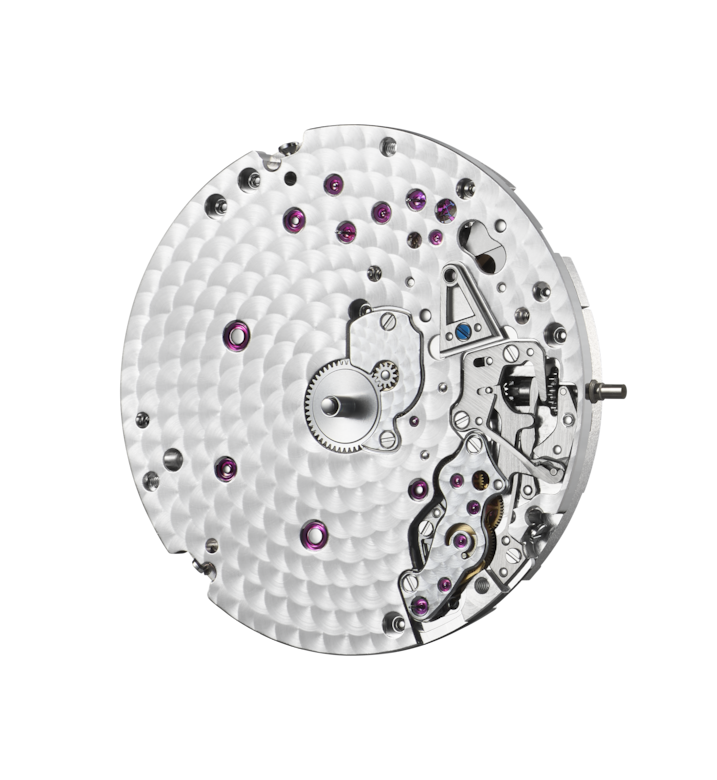
© © Armin Strom AG · SourceThe movement has two independent barrels and two regulators. Its frequency is 3.5 Hz, or 25 200 vibrations per hour. Building this arrangement is considerably more complex than simply exposing part of an ordinary calibre: both systems need power, and their interaction needs to be maintained. Manual winding leaves the back free of a rotor, so the symmetrical wheels and bridges are clearly visible through the caseback.
Practical meaning
The two blue seconds counters have a purpose too. Their hands turn in opposite directions; a pusher beside the two o'clock marker resets both to zero. Armin Strom specifies that this happens without stopping the movement. You can observe the two indications continuing to run together. This resets the running seconds rather than providing a built-in chronograph for measuring an event's duration.
 Enlarge
The back of the hand-wound ARF21: the movement's symmetry remains visible without an automatic winding rotor.
© © Armin Strom AG · SourceThe example here is the Manufacture Edition Blue ST22-RF.05, presented on February 28, 2023, in a series of 50 pieces. Its steel case is 43 mm in diameter and 11.55 mm thick; the current product page also gives a lug-to-lug length of 49.60 mm. The calibre comprises 276 components and 39 jewels. The exposed mechanics occupy a large part of the composition, so when trying it on I would specifically check how easily the time indication, offset to the right, can be read.
There is an important mismatch in the official power-reserve figures. The Blue release dated February 28, 2023, states 48 hours, while the current ARF21 page states 80 hours. The materials consulted do not explain whether the difference reflects a movement update or a correction to the listing. I therefore keep both figures with their origins. Before planning a winding routine, a buyer of a particular example should obtain confirmation of its version and power reserve from Armin Strom.