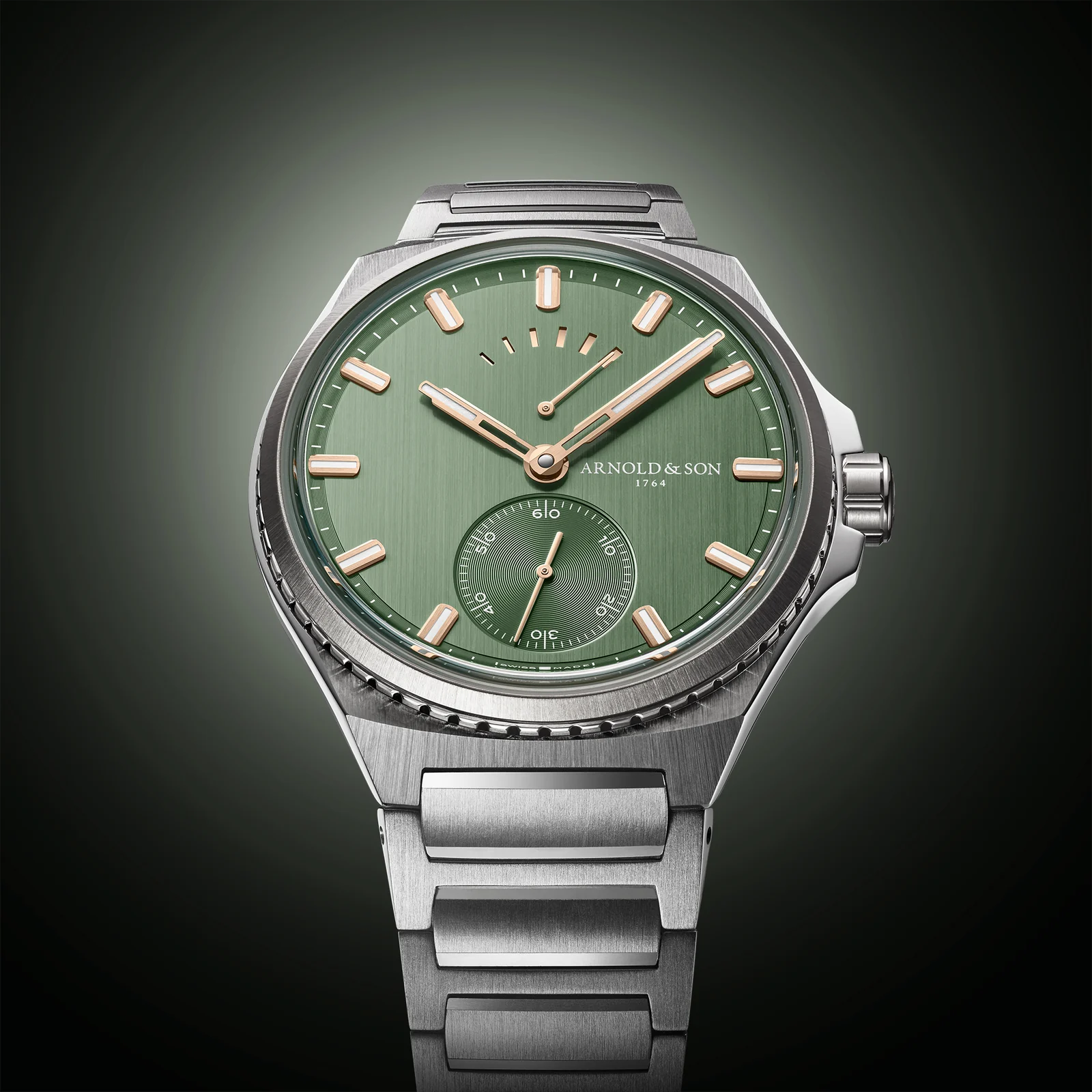
Arnold & Son · Luna Magna Red Gold Meteorite
The model in detail
Meet the watch
Luna Magna becomes most interesting below the hands: a moon globe measuring 12 mm across rises above the dial. As it rotates, it presents different proportions of its light and dark halves. In the established Red Gold Meteorite version, reference 1LMAR.Z01A.C211R, the idea feels particularly convincing: meteorite forms both the background and part of the celestial body itself. This is a watch worth viewing at an angle, because its composition develops vertically as well as across the dial.
The blue colour comes from PVD treatment of iron meteorite. Official close-up photographs reveal the intersecting lines of its structure, known as Widmanstätten patterns. One half of the globe uses the same material, while the other is white Cacholong opal. The opal half of the moon and the white time subdial carry Super-LumiNova. The familiar contrast between the moon’s light and dark surfaces therefore works as both pattern and volume, gaining another expressive layer at night.
 Enlarge
Close-up of the 12 mm globe: blue meteorite meets the white Cacholong-opal hemisphere.
© Arnold & Son · SourceHours and minutes sit at 12 o’clock, leaving the lower half of the composition to the moon. It is a good way to keep the unusual display uncluttered: Roman numerals and two hands occupy their own circle, while the lunar phase can be read separately. A large case, however, does not automatically provide an equally large time scale. During a fitting, check the small upper dial and the angle at which the sphere is visible, rather than judging legibility by the watch’s diameter alone.
Details and limitations
The manufacture A&S1021 is manually wound, runs at 3 Hz and contains 35 jewels. Its layout is more interesting than the bare figures. Without the moon globe, the movement is 4.75 mm thick; with it, the figure rises to 12 mm. The sphere occupies space on both sides of the movement, and domed sapphire crystals help accommodate it within an overall case height of 15.90 mm. There is a clear reason for the thickness: a small mechanical sculpture needs room, and the designers have made that volume a visible part of the watch.
The stated 90-hour power reserve amounts to three days and 18 hours. That is a convenient interval for a hand-wound watch: it can be set aside briefly without losing either its running time or the moon’s position. The lunar display nevertheless moves with the mechanism. If the movement stops, its indication needs to be brought back into agreement with the sky. A long reserve reduces how often this happens, but the owner still needs a regular winding habit, particularly when alternating Luna Magna with other watches.
The figure of 122 years concerns the accumulation of a one-day error in the lunar indication, assuming uninterrupted running and a correct initial setting. It says nothing about the hands’ daily rate and does not mean that the watch can go that long without servicing. The attraction of this gearing lies in bringing together two scales: familiar hours and minutes, and the slow lunar cycle. The result looks calm on the wrist, although the sphere’s unusual rotational speed requires precise calculation.
A separate moon-age scale on the back assists setting. The manual shows eight principal stages, helping position the sphere more precisely than judging its front by eye. In the crown’s second position, the phase can be adjusted in either direction independently of the time; the manufacturer permits this at any moment. That is an important practical detail: after a break from wearing the watch, the complicated display can be restored without a separate corrector or moving the hour and minute hands.
 Enlarge
The back reveals A&S1021 and the moon-age scale used for precise phase setting through the crown.
© Arnold & Son · SourceA 44 mm case in 5N red gold, a height of 15.90 mm and an alligator strap give the watch a definite character. Before buying, check its fit and clearance beneath a cuff; photographs cannot establish either. Stated water resistance is 3 bar, and the manual specifically warns that leather straps are unsuitable for water sports. The edition numbers just 38 pieces. Luna Magna is most compelling for someone seeking an uncommon way to display time and willing to attend to manual winding for the pleasure of this slowly changing scene.