Ferdinand Berthoud · Chronomètre FB 1R.6-1
The model in detail
Meet the watch
The history of this particular model has a precise starting point: Marine Clock No. 7, made by Ferdinand Berthoud in 1767. The modern Chronomètre FB 1R.6-1 was introduced in 2018 and limited to twenty numbered examples. This is a retrospective review in which the historical connection explains the construction rather than replacing it with an account of the entire brand.
The regulator display separates its functions. Hours appear on a sapphire disc at 2 o’clock, minutes in the upper counter, a long seconds hand runs from the centre, and power reserve sits at 10. The layout uses the reverse of the regulator mechanism’s plate, with black rhodium plating. The owner has to become accustomed to assembling the time from several areas instead of a familiar pair of central hands.
As the barrel’s mainspring unwinds, its torque changes. A conical fusée and a chain of 474 steel links sit between the barrel and the wheel train. The chain works at different radii on the cone: decreasing spring force is compensated by a longer lever arm. This mechanically evens out the supply of energy; it is not a remontoire with a small spring periodically recharged.
 Enlarge
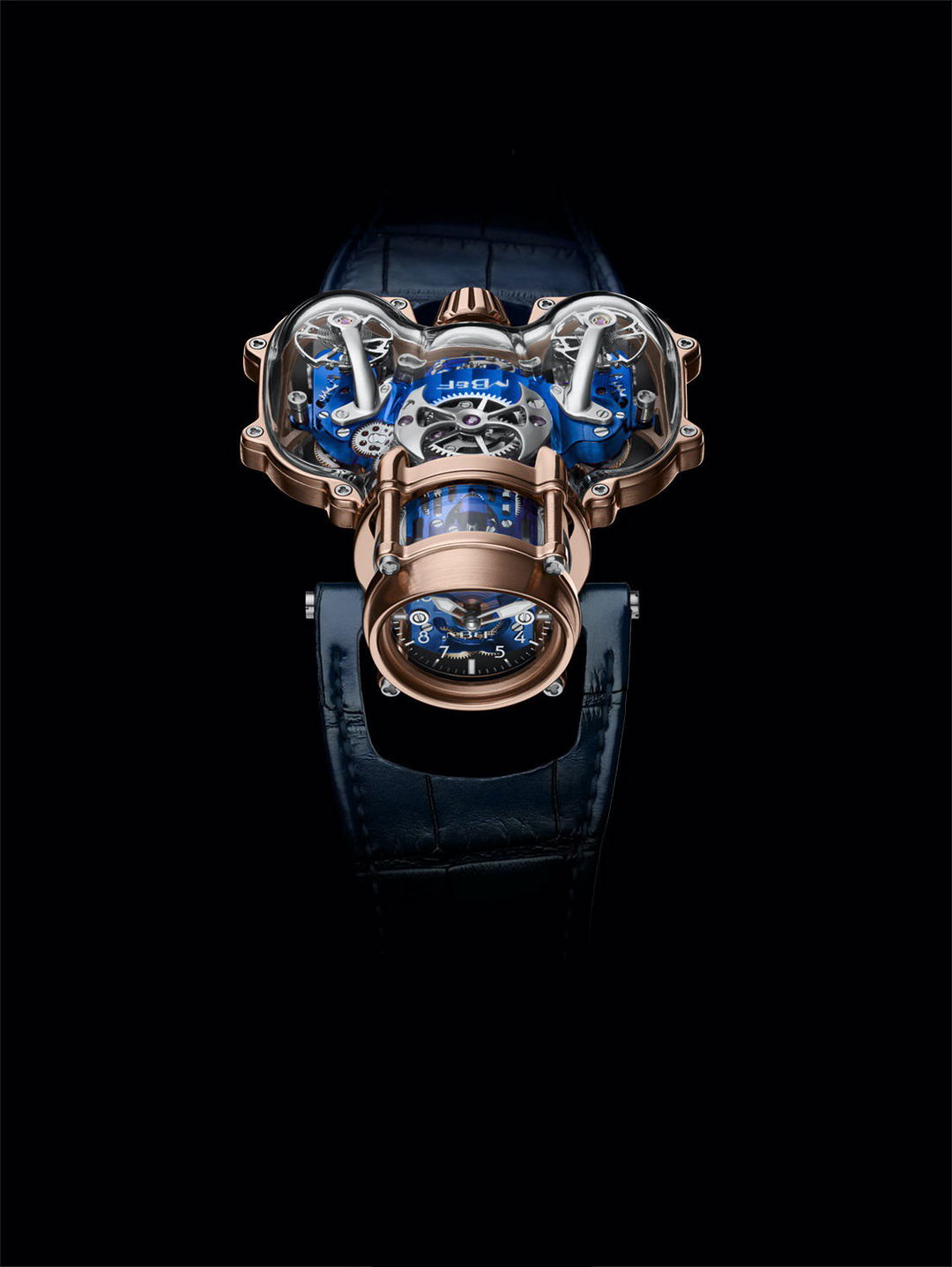
The back of FB 1R.6-1: the barrel and fusée sit above the tourbillon in a pillar-built movement. The chain transmits torque between them.
© Chronométrie Ferdinand Berthoud · SourceDetails and limitations
The manually wound FB-T.FC.R calibre uses pillar construction; its barrel and fusée are inverted and supported from one side to save height. The tourbillon sits at the back, while seconds are routed to a central hand. Frequency is 3 Hz and power reserve is 53 hours. The manufacturer specifies COSC certification: this tests chronometric characteristics rather than promising freedom from servicing or identical rates in every condition.
The octagonal case, 44 mm across and 13.95 mm thick, is made from carburised stainless steel. Thermochemical treatment strengthens the surface layer; the stated surface hardness is 1,200 Vickers. This surface property should not be equated with invulnerability of the entire object. A 30 m water-resistance rating also places the watch in the realm of careful daily wear.
The archived GPHG entry for FB 1R.6-1 lists CHF 230,000 including VAT. This belongs to the model’s historical competition record, not to a present-day secondary-market offer. Availability is unconfirmed. Here rarity is measured in twenty examples, while the interest lies in how a marine chronometer’s chain transmission is incorporated into a wrist-worn regulator with a tourbillon.