
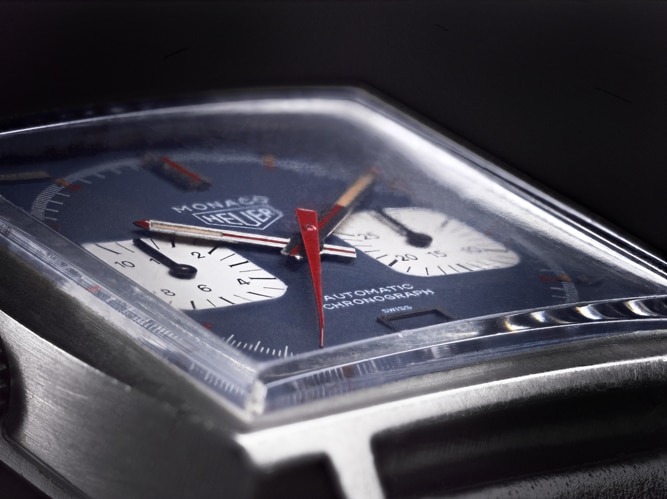
Heuer · Monaco 1133B
The model in detail
Meet the watch
The square on Michael Delaney's wrist stands out even beside his racing suit. In Le Mans, Steve McQueen wears the blue Heuer Monaco 1133B; TAG Heuer explicitly identifies this reference as the screen model. For a cinema feature, this is a welcome case where the exact watch can be named, rather than guessed from a similar silhouette in a frame.
The Monaco arrived in 1969 as a platform for Calibre 11, one of the first automatic chronographs. Its automatic winding uses a micro-rotor; the square case has chronograph pushers on the right and the winding crown on the left. That arrangement immediately distinguishes it from the usual chronograph with a crown between the pushers.
For filming in 1970, Heuer sent several identical 1133B watches: working duplicates and watches for photographs were needed. McQueen played the driver Delaney, with his look drawing on contemporary motor racing and driver Jo Siffert. Even an authentic 1133B therefore needs provenance if a seller calls it a screen-used example. The same reference confirms the model, but not an individual watch's history.
Details and limitations
The historic case is 39 mm wide, with 22 mm between the lugs. Its screen look comprises a dark-blue dial, two white counters, red accents and a date at the bottom. Early versions marked “Chronomatic” differ from McQueen's later standard 1133B. The article photograph shows an archive model from TAG Heuer's page, rather than a specific watch from the film.
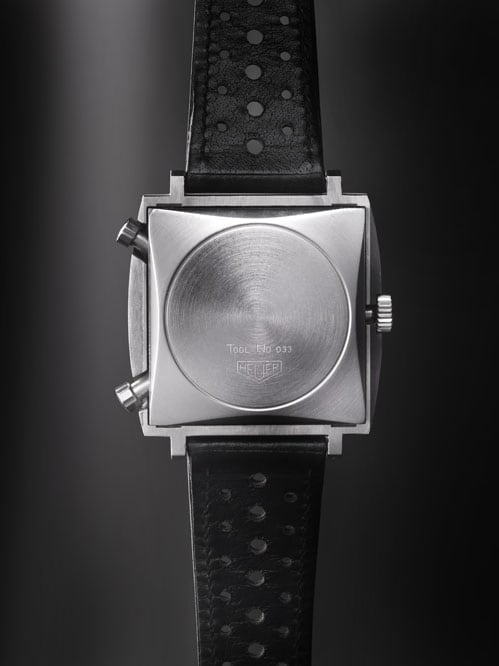 Enlarge
Archive 1133B viewed from its solid case back. Model photograph supplied by TAG Heuer; it does not certify screen-used provenance for a particular watch.
© © TAG Heuer · SourceThe documented screen-used 1133B discussed by Sotheby's has an automatic Calibre 11. TAG Heuer notes that vintage 1133 watches came with Calibre 11 and 12. The cited sources do not give a power reserve for the actual screen-used example; applying the 40-hour specification of a modern Monaco to a 1970 watch would be a mistake.
On 15 June 2026, Sotheby's reported the sale of one confirmed screen-used 1133B for US$640 000 at auction in New York. That is a result for an object with special history, rather than the ordinary price of a vintage Monaco. If you want this design to wear, compare a modern model using its own reference and calibre: a cinema connection does not turn a reissue into a prop.