
Christiaan van der Klaauw · CVDK Planetarium Black Aventurine
The model in detail
Meet the watch
Saturn in the lower part of the CVDK Planetarium takes 29.46 years to return to its starting point. Beside an ordinary minute hand, that duration is almost impossible to picture, which is precisely what makes the watch interesting. Its mechanics let us observe time on human and planetary scales at once. The family began in 1999; this review considers the current Planetarium Black Aventurine, reference CKPT33B4, with its manufacture automatic movement. It is an expressive example of a long-standing idea evolving alongside the technical foundation of the watch.
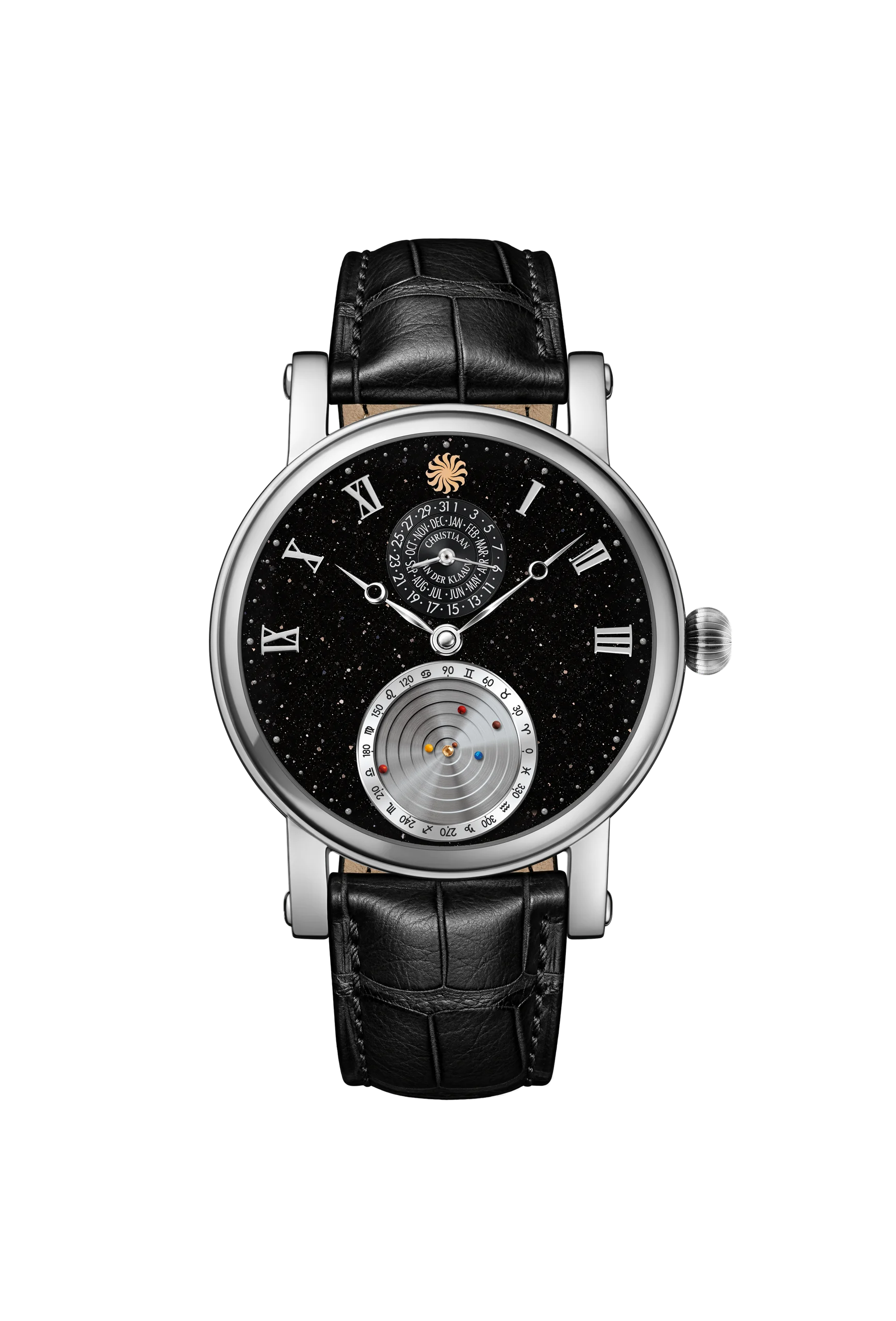
The Planetarium sits at 6 o’clock. The Sun occupies its centre, surrounded by Mercury, Venus, Earth, Mars, Jupiter and Saturn. This arrangement is heliocentric: the position of each celestial body is referenced to the Sun. The sequence of circular tracks helps explain the layout without a separate key, while the coloured Earth provides a useful point of reference. There are six planets here, so a complete depiction of today’s eight-planet Solar System should not be expected. The manufacturer describes this module as the world’s smallest mechanical planetarium.
The mechanism’s principal task is to reconcile radically different periods. Mercury completes an orbit in 87.97 days, Venus in 224.70, Earth in 365.24 and Mars in 686.98; Jupiter needs 11.86 years. Gear ratios translate the watch’s running into these very slow cycles. Mercury’s stated period works out at about four degrees of movement per day, whereas Saturn needs roughly a month to move one degree. This calculation from the brand’s figures explains the complication’s character: comparing changes over weeks and months is more rewarding than waiting for a spectacle during a brief demonstration.
Details and limitations
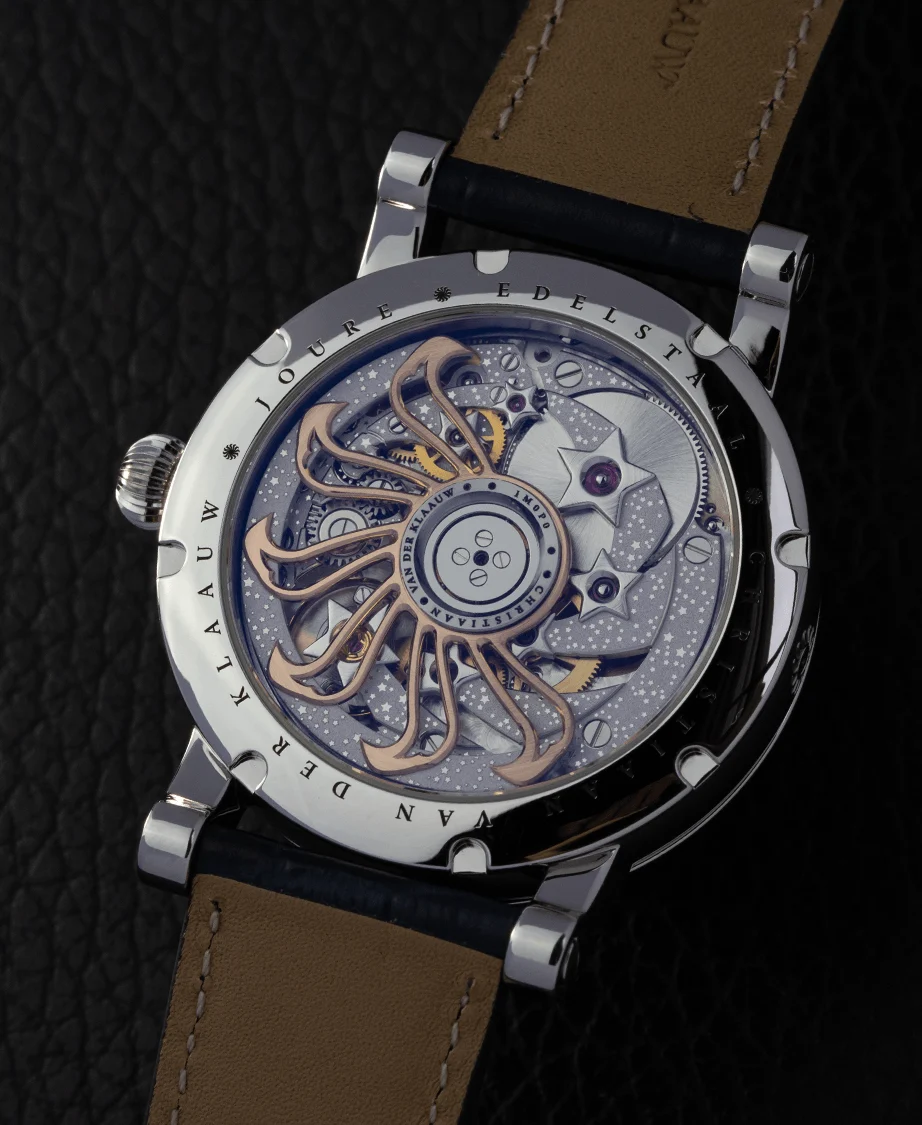
The current CKPT33B4 specification lists the automatic CKM-01 Manufacture with 32 jewels and a 60-hour power reserve. It drives the hands and calendar, while a separate module establishes the planetary cycles. The brand’s manufacture platform appeared in 2024; its features include a variable-inertia balance and a free-sprung hairspring. In simpler terms, the rate is adjusted by changing the balance’s inertia. Through the sapphire caseback are star-shaped bridges and an openworked rotor shaped like the brand’s Sun, with rose-gold plating. The astronomical theme continues on the reverse.
 Enlarge
CKM-01 through the sapphire caseback: openworked Sun rotor and star-shaped bridges.
© Christiaan van der Klaauw · SourceThe black background is made from aventurine glass. Its points of reflected light create a starry setting in which the silver-coloured planetarium looks particularly at home. Rhodium-plated hour markers and hands separate ordinary time from the little model of the heavens, while the date and month share the upper display. The composition retains a clear vertical structure: calendar above, planets below, central hands between them. The attraction lies in familiar indications sharing space with something usually encountered in an astronomy textbook; the decorative background ties them together visually.
The steel case measures 40 mm in diameter, with sapphire crystals front and back. A black ostrich-foot leather strap fastens with a steel folding clasp. On paper, the diameter is restrained for such a busy dial, although that number alone cannot establish the fit: the lug shape and overall profile deserve a check on your own wrist. Steel also suits the character of the model. Attention remains on miniature astronomy rather than a precious-metal case, and everyday time is still read from central hands.
The most important everyday consideration is keeping the watch running. The stated 60 hours amount to only two and a half days: after a long interruption, the indications will need to be brought back into line with the current time. The brand supplies its Astronomical Masterpieces collection with a removable Swiss Kubik watch winder, a genuinely useful addition here. A buyer is choosing a watch whose slow changes invite observation over years. If that prospect appeals, the Planetarium offers uncommon substance; if the main pleasure is immediately visible mechanical action, its quiet pace may feel too restrained.

