Piaget · Andy Warhol Camouflage
The model in detail
Meet the watch
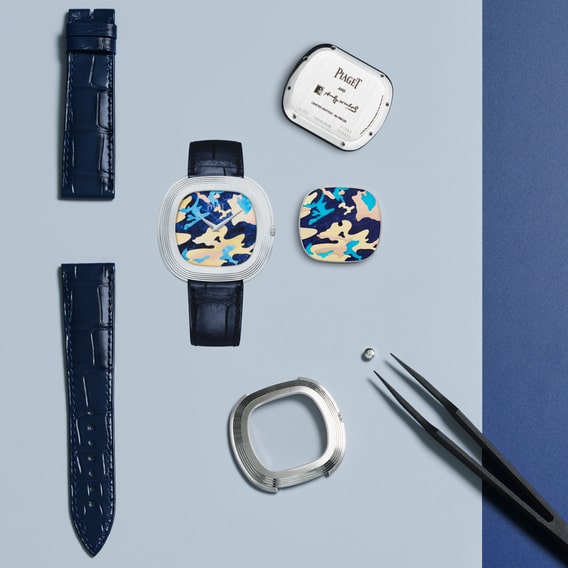
The Piaget Andy Warhol Camouflage has a pleasing audacity: its camouflage is designed to get the watch noticed. Turquoise islands, deep blue stone and gold patches fill a large cushion-shaped case, turning a familiar military pattern into jewellery. The new edition continues the collaboration with The Andy Warhol Foundation for the Visual Arts and draws on the Camouflage self-portraits of 1986. That explains the run of 86 pieces. Wallpaper* published its recent article on 5 November 2026; Piaget's official page does not give an exact premiere date. It is a rewarding subject for the collection: the image has a much closer connection to the artist than a signature on a caseback alone.
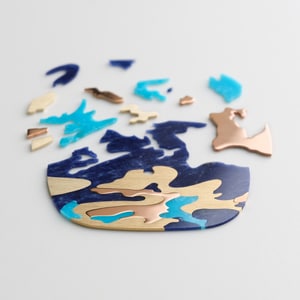
The main attraction deserves a close look. The marquetry combines sodalite and turquoise with satin-finished yellow gold and polished rose gold. Piaget shows individual shaped elements and the composition being assembled with tweezers: the colour comes from the material itself rather than a print applied on top. Dark sodalite gives the pattern depth, turquoise increases its brightness, and the gold areas introduce two different types of reflection. Comparing the completed dial with the separate components is particularly interesting in the official photographs. The complexity becomes apparent at the edges of the patches, where entirely different materials meet. That is often where the distinction between an attractive pattern and convincing craftsmanship becomes visible.
 Enlarge
Shaped sodalite, turquoise and gold components before final dial assembly.
© Piaget · SourceReference G0A51242 has an 18-carat white gold case with a rhodium finish. Its 45 × 43 mm dimensions give fair warning: this is a conspicuous object on the wrist, even at just 8.08 mm thick. The stepped frame establishes its own rhythm around the camouflage's free-flowing outlines, giving the composition greater coherence. Treating this shape as equivalent to a round 43 mm watch would be a mistake: the corners and broad shoulders occupy space differently. The slimness helps the profile but does not cancel out the surface area. Trying it on matters more here than the familiar diameter figure in a shop's search filter.
Details and limitations
Inside is the manufacture automatic 501P1: 23 jewels, 28,800 vibrations per hour, approximately 40 hours of power reserve and a movement thickness of 3.63 mm. It displays only hours and minutes, so the dial need not surrender space to a date window or seconds subdial. Technically, it is a restrained choice for an emotional design. A 4 Hz frequency alone does not promise a particular accuracy, while the thin construction explains how the watch maintains a relatively flat profile. The main everyday compromise concerns rotating a collection: after two days off the wrist, the watch will usually need winding again. Automatic winding is useful for regular wear, but it cannot replace a long reserve in a collection where watches rotate frequently.
Two hands leave almost the entire stage to the stone. In the photographs they have fairly distinct outlines, but their polished surfaces share space with reflective gold fragments; instant readability under every lighting condition deserves an in-person check. A blue alligator leather strap continues the palette and fastens with a conventional pin buckle. The stated water resistance of 3 bar, together with that strap, suggests careful urban use: a walk, meeting, dinner or visit to an exhibition. The camouflage motif can easily suggest field watches, but choosing this Camouflage for water or sporting activity would be peculiar. Its natural setting is about clothing and visual combinations.
Piaget's official US collection page lists the price as available on request; that is no substitute for a confirmed local offer in Uzbekistan. Assessing the purchase solely through the 501P1's specifications would also miss much of the interest: the appeal lies in the stone composition, gold case and specific artistic connection. In our view, Camouflage's greatest strength is that its designers preserve the pattern's identity without placing a literal portrait on the dial. The result is a self-contained piece of jewellery with something to show both at a distance and under a loupe. A run of 86 adds rarity but offers no guarantee of future returns. These watches are more logically chosen for the desire to wear them than for calculations about the next auction.