
PS Horology · Tsuba 1720
The model in detail
Meet the watch
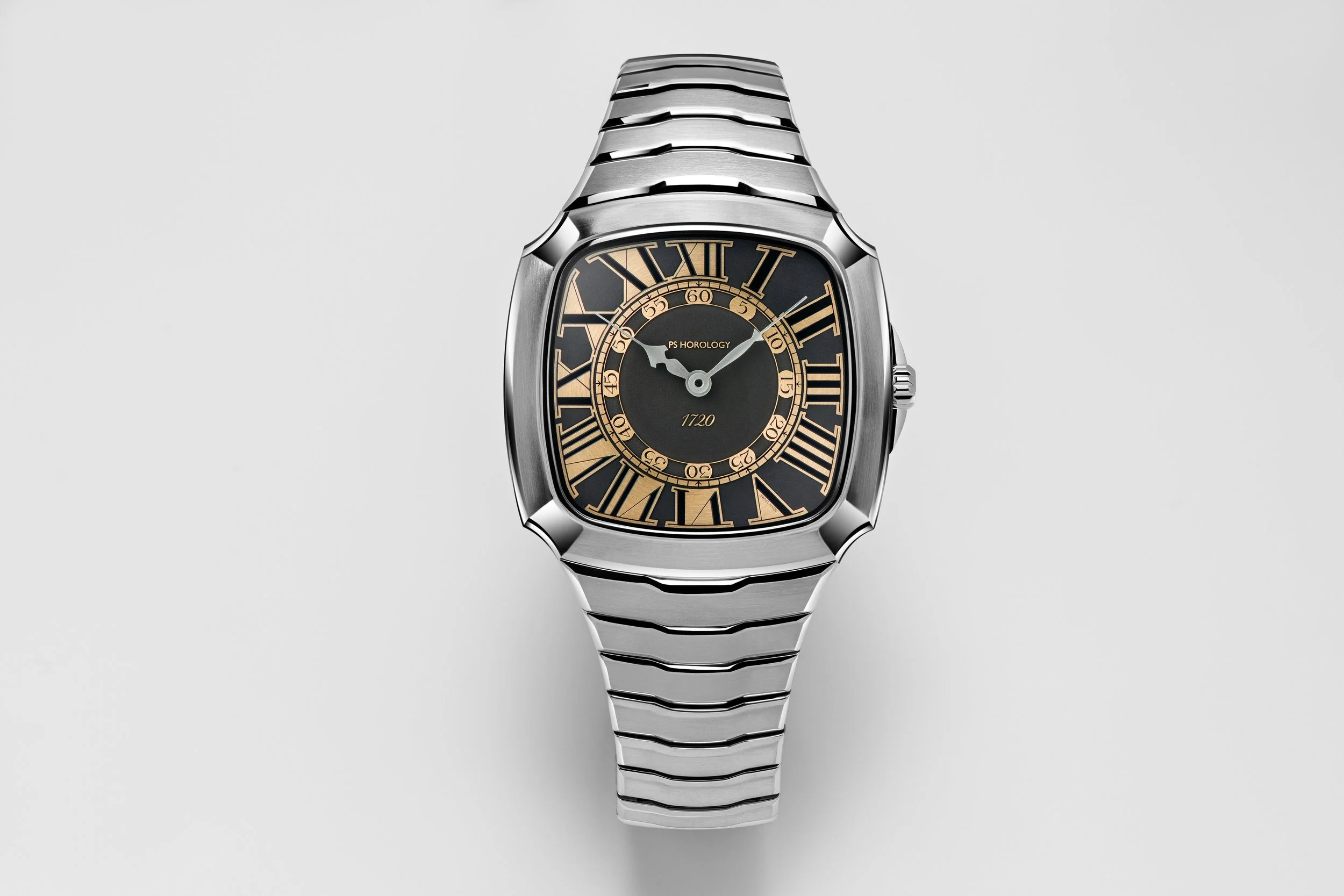
The first thing you notice on the Tsuba 1720 is its oversized Roman numerals. Then comes the catch: the minute scale sits inside the hours. For an accustomed eye, this small rearrangement has considerable consequences. PS Horology had to rethink which part of each hand should point to the relevant graduation. That problem is the most interesting aspect of Peter Speake and Farhana Safa’s new work dedicated to English watchmaker George Graham.
The historical starting point is specific. The Metropolitan Museum of Art holds Graham’s pair-case quarter-repeating pocket watch, dated 1719–20: its inner gold case belongs to the first year and its outer case to the second. On its gold champlevé-enamel dial, the minute track runs outside the hours, with blued beetle-and-poker hands indicating the time. PS Horology brings that graphic vocabulary into the Tsuba’s square composition while reversing the scales. The historical repeater mechanism does not carry over into the new watch.
Reversing the rings could have turned familiar hands into a source of confusion. The beetle hour hand therefore retains its characteristic broad section but gains a slender extension reaching the outer hours. The poker minute hand receives a transverse shelf beside the inner minute track. You need to read the part of each hand that corresponds to its scale, rather than automatically looking for the longest pointer to tell the minutes. Only an in-person encounter can establish how quickly that method becomes familiar.
Details and limitations
The dial is made of 18k gold and finished by hand. The manufacturer combines laser engraving, ceramic lacquer and polishing; the Roman numerals are lacquered by hand. The historical reference and current manufacturing technique must be distinguished: modern lacquer should not be called antique champlevé enamel. The black background and gold lines create dense graphics, with the large hours forming an almost architectural frame around the minutes. Omitting a separate running-seconds display leaves a two-hand composition.
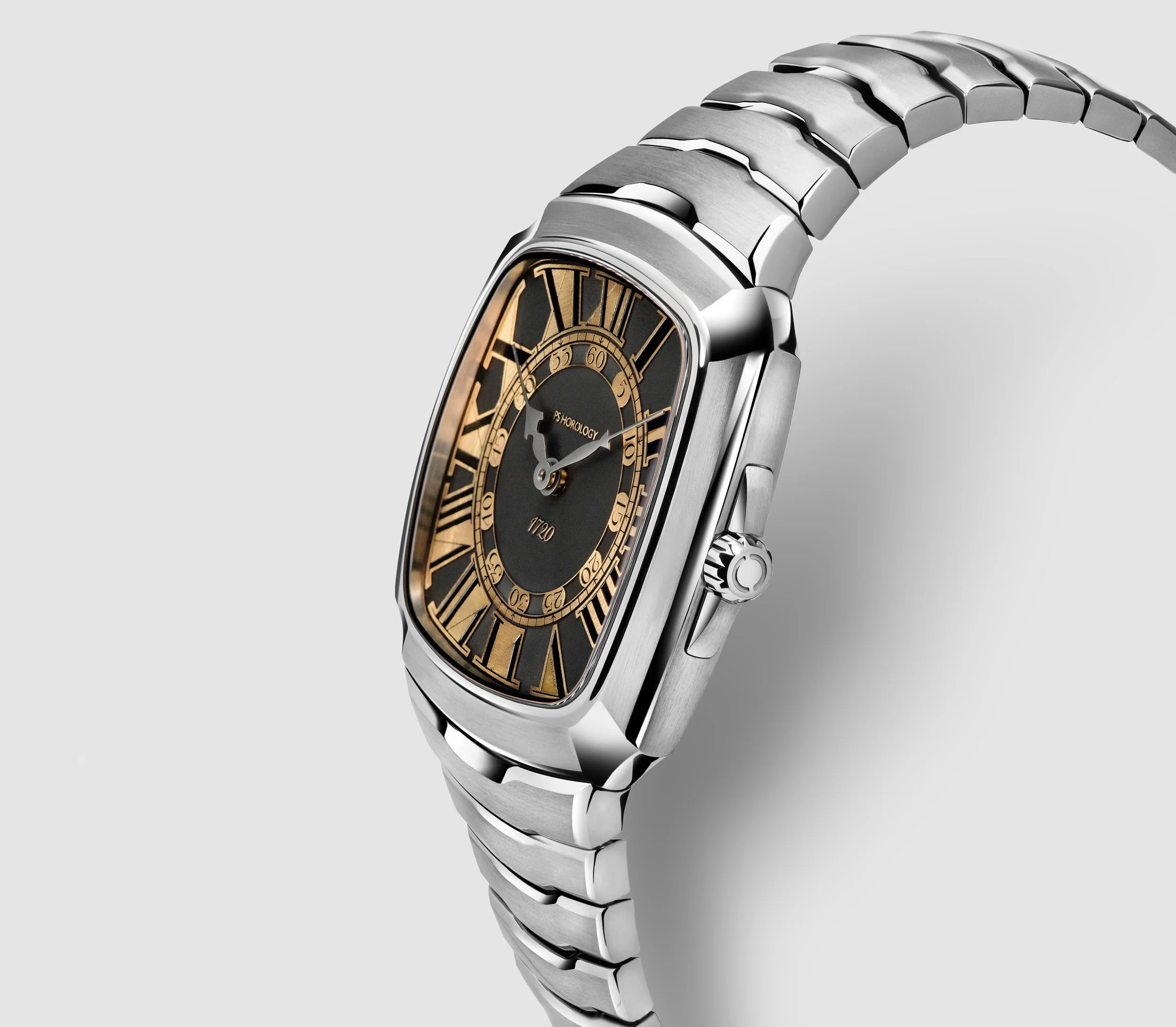
The 316L steel case measures 38.3 mm across from three to nine o’clock, excluding the crown, and 8.91 mm thick. Diameter is not the precise term for this non-round shape. Sapphire crystals are fitted on both sides, and the stated water resistance is 3 atmospheres. The modest thickness helps explain the balanced proportions in photographs, but a steel bracelet and sporty outlines do not make this a watch for swimming.
 Enlarge
Side view: the slim case and first links of the integrated bracelet.
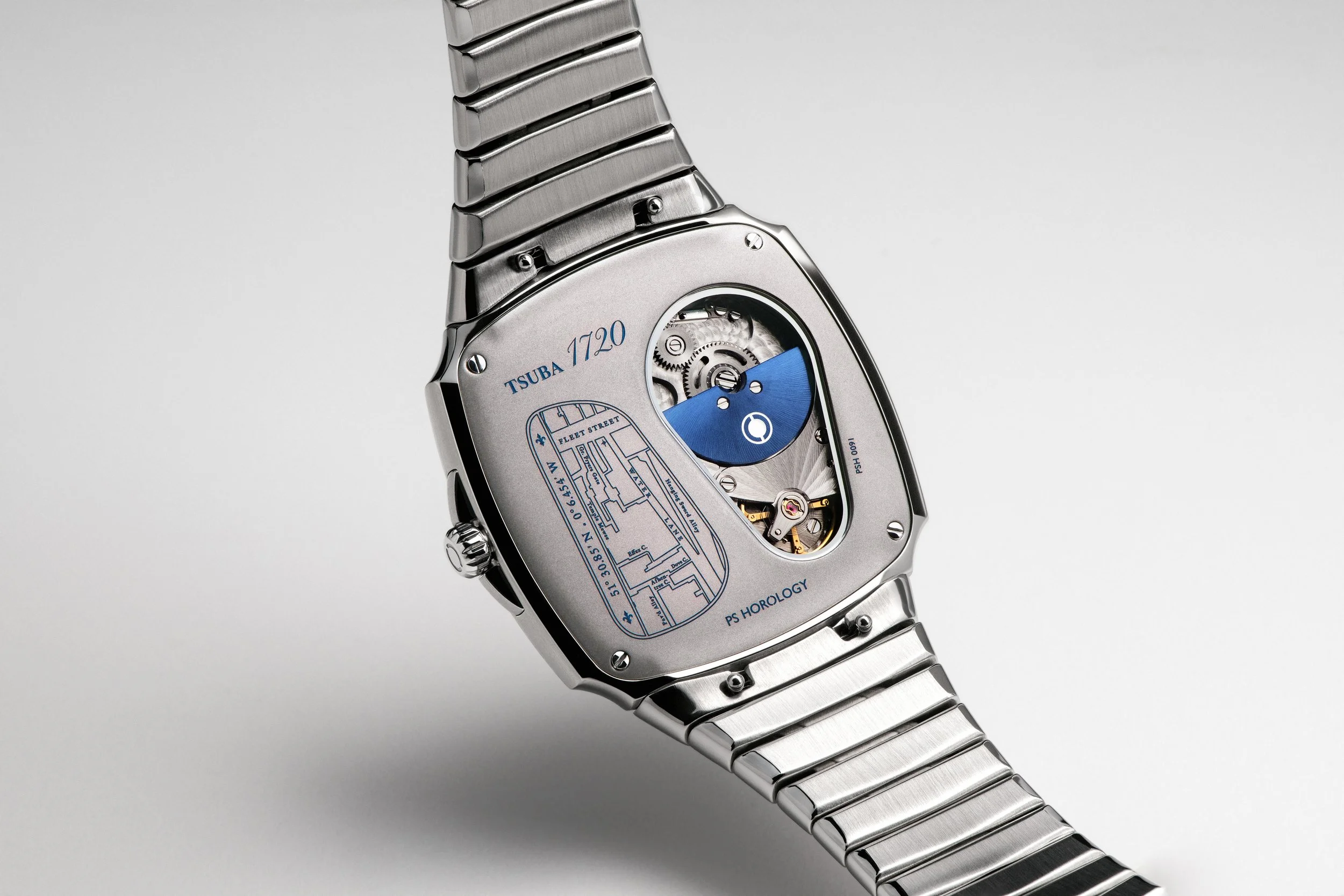
© PS Horology · SourceInside is the automatic Vaucher 5401, measuring 2.60 mm thick and fitted with a tungsten micro-rotor. Its free-sprung balance runs at 3 Hz, and power reserve is 48 hours. A compact rotor dispenses with the large rotating disc over the whole movement, supporting the slim-case brief. However, a two-day reserve requires normal owner discipline: after a full weekend unworn, the watch may need winding and resetting.
The bracelet has received a more consequential change than the frontal photograph suggests: its first links now pivot directly at the case. This should help the bracelet wrap around the wrist sooner, although case dimensions alone cannot predict fit. A concealed link-adjustment system and a push-button butterfly clasp maintain the clean exterior line. Streets and coordinates of Graham’s London workshop are engraved on the caseback, continuing the historical reference where the dial is no longer visible.
 Enlarge
The caseback with its historical map and window onto the Vaucher 5401 micro-rotor.
© PS Horology · SourceThe edition comprises 28 pieces. The Tsuba 1720’s strength lies in the consistency of its decisions: rearranged scales demanded new hands, a thin movement supported the proportions, and articulated first links addressed the practical question of fit. Buyers still need to check the essential point in person: whether they enjoy both the unusual dial and its everyday way of telling time.

