Czapek Genève · Quai des Bergues Sapphire Blue S / SXH1
The movement in detail
The movement’s idea
The two small scales of the Quai des Bergues seem to balance each other across the lower dial: seconds on the left, power reserve on the right. Sapphire Blue S makes it easy to see why the arrangement works. The large hands remain the priority, with supporting information kept in its place. This watch invites you to notice time passing without turning the dial into an instrument panel. Blue catches your eye first, but the placement of the functions defines its character.
SXH1 emerged from Czapek’s collaboration with Jean-François Mojon’s Chronode. For a small independent brand, this matters: a distinctive identity does not require pretending that every skill is housed under one roof. A good partnership should be judged by its result. Here, movement and display speak the same language, so naming the partner does not weaken Czapek’s authorship. It helps explain how projects of this kind become possible at all.
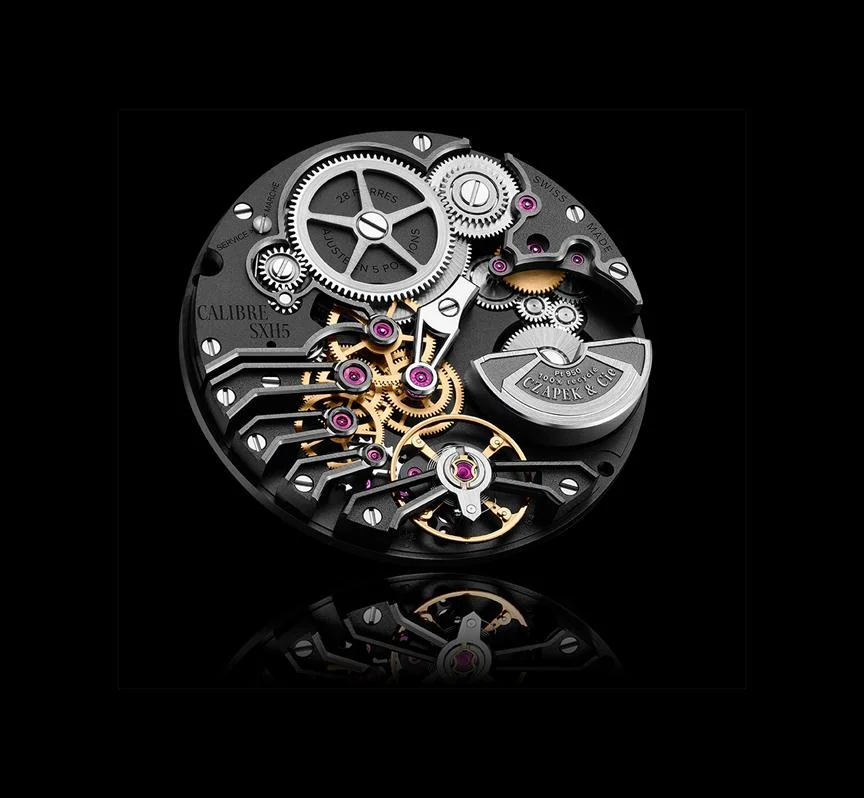
Manual winding, twin barrels and seven days of autonomy suggest a clear routine: rather than putting the watch on a winder, occasionally restore its energy through the crown. Frequency is 3 Hz; the movement measures 32 mm across and 4.75 mm thick. A long reserve is not, by itself, a promise of identical accuracy throughout the running period. Its practical value is simpler: greater freedom to rotate several watches, while an indicator reminds you when winding is due.
 Enlarge
SXH1: a hand-wound movement with twin barrels and an open bridge architecture.
© Czapek & Cie SA · SourcePractical meaning
The Ricochet pattern is stamped into a silver base before blue enamel is applied and fired. The word flinqué should therefore not automatically be understood as a pattern cut entirely by hand into each individual dial. Accurate terminology does not make the surface less interesting. Understanding the real sequence of operations is more useful than surrendering attention to a vague appeal to craftsmanship. In the official photograph, the pattern remains delicate enough not to distract from the indications.
The Sapphire Blue S has a 38.5 mm steel case. A sapphire back lets you study the movement’s finishing while the front retains a closed, composed appearance. This combination is particularly convincing: mechanics need not be permanently on display. The limitation is equally specific: despite the 50 m rating, Czapek explicitly advises against swimming with this model. Choose it for its pattern, proportions and weekly ritual, not as an all-purpose sports instrument.