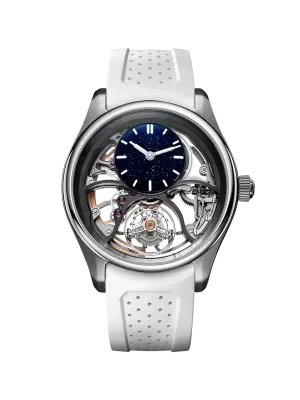
H. Moser & Cie. · Pioneer Tourbillon Arctic Fizz
The model in detail
Meet the watch
Arctic Fizz starts with an unusual proposition: put a complex regulator in a watch with a titanium bracelet and a rotating bezel. Reference 3805-0500 retains a 40 mm diameter. It is an uncommon combination for someone interested in high-end mechanics who does not always want a formal watch on leather. Comfort would be premature to promise without trying it on: the case profile and bracelet fit matter too.
The opening at six reveals the tourbillon. Its purpose is to change the balance and escapement’s orientation relative to gravity, averaging out certain positional errors. It does not guarantee better accuracy than every other wristwatch: adjustment, movement condition and wearing habits affect the result. The rotating cage lets the wearer observe the regulator from the dial side.
Moser’s distinctive feature is a pair of matched balance hairsprings. The manufacturer explains their purpose as compensating for shifts in the springs’ centres of gravity as they expand and contract. Here two springs operate within one regulator; they should not be confused with two independent balances in a resonance watch. Automatic HMC 805 has partially openworked bridges and bidirectional winding, with a 72-hour reserve.
 Enlarge
HMC 805 through the caseback: the automatic winding rotor and partially openworked bridges.
© H. Moser & Cie. · SourceDetails and limitations
Arctic Blue describes the dial: its light centre darkens towards the edge, while a granular, frosted texture breaks up reflections. This is the artistic element of the new version. The double-hairspring tourbillon itself was not invented specifically for Arctic Fizz. A sapphire caseback reveals HMC 805’s architecture and rotor, complementing the open regulator on the front.
The official product page lists 12 ATM water resistance and CHF 54,900 excluding VAT; production is limited to 100 watches. This is the brand’s Swiss price, not the final cost of importing into Uzbekistan. The model appeared in the watch press on 19 November 2026, although the manufacturer’s open product page does not state an exact announcement date. The novelty is this particular execution, rather than a newly invented escapement type.