Girard-Perregaux · Neo Constant Escapement
The movement in detail
The movement’s idea
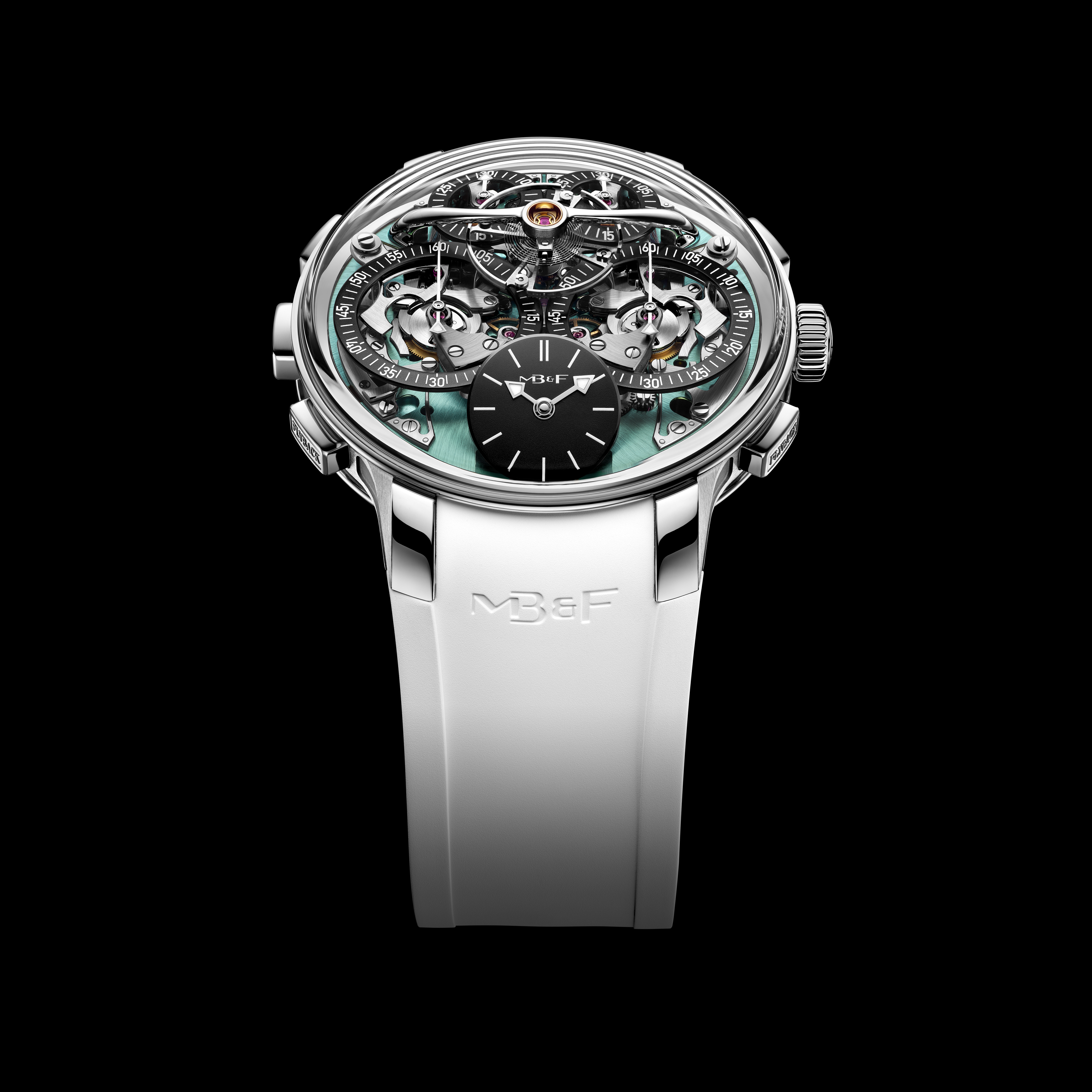
The most interesting detail in the Neo Constant Escapement is the thin silicon blade in the lower part of its exposed movement. It flexes and snaps between two stable states. The GP09200 calibre is built around that action: supplying uniform impulses to the balance as the energy in the mainspring barrels gradually declines.
Think of an ordinary mainspring as a full and almost empty tank, except that the delivery force changes too. The balance receives energy through the gear train and escapement. Changing supply conditions can change its swing, which can affect timekeeping. A long power reserve alone therefore tells us little about how evenly a watch will run throughout that period.
Girard-Perregaux exploits the elasticity of a pre-buckled silicon blade. Before it switches to the other state, the system must overcome a threshold. This meters energy close to the regulating organ. A useful analogy is a curved card held between your fingers: it resists, then suddenly bends the other way. That illustrates the principle rather than modelling the complete mechanism.
 Enlarge
Neo Constant Escapement: exposed movement architecture in a titanium case.
© Girard-Perregaux · SourcePractical meaning
It is essential to distinguish consistency from absolute accuracy. Uniform impulses help preserve the balance’s operating conditions, but do not in themselves promise zero error. Regulation remains necessary. The appeal of the Neo Constant Escapement is its control of one source of instability, rather than a promise to defeat every influence on a mechanical watch.
The lineage goes back to the Constant Escapement L.M., which won the top GPHG award in 2013; the Neo arrived in 2023. Its appearance expresses its purpose: working components occupy the space of a conventional closed dial. It invites observation as a small functioning instrument. For a reader interested in movements, that has more appeal than another decorative interpretation of a familiar calibre.
My choice here is the engineering idea itself. It invites us to judge watches by the quality of energy delivery as well as their complication count. Before buying, I would try the case on and discuss servicing this unusual escapement with the authorised service centre. Its collecting appeal comes alive when the owner wants to understand how it works.