MB&F · Legacy Machine Sequential Flyback EVO — Aquamarine
The movement in detail
The movement’s idea
Most watches have one stopwatch and a familiar sequence: start, stop, reset. The MB&F Legacy Machine Sequential Flyback EVO has two, which can be controlled separately or with one shared button. We examine the 2026 titanium version with an aquamarine dial plate: its appeal begins not with a component count, but with an unusual way to measure multiple intervals.
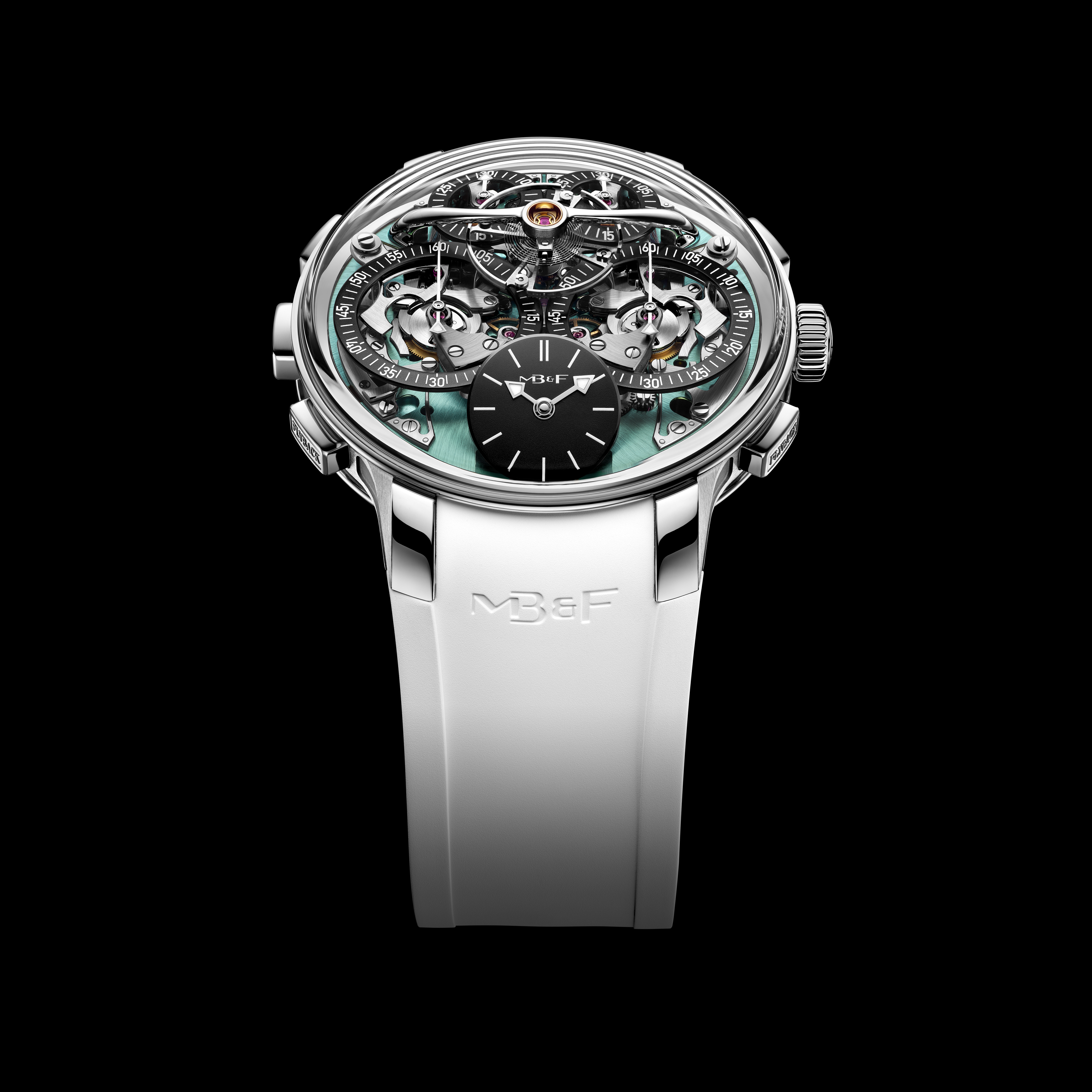
The dial can be confusing at first. The left chronograph shows seconds at 9 o'clock and minutes at 11; the corresponding right-hand counters sit at 3 and 1. Ordinary time is displayed on the inclined dial below. This separation makes the mechanism's operation visible, but takes some learning: moving your eye between two stopwatches is more involved than following a single central hand.
Twinverter is the fifth button, on the left at 9 o'clock. It reverses the state of both chronographs. If both are stopped, both start. If both are running, both stop. If only one is running, it stops and the other begins timing. This is not electronic programming but mechanical control developed by Stephen McDonnell for MB&F.
Practical meaning
That creates a useful sequential-timing scenario. The first stopwatch measures one stage; pressing Twinverter preserves its result and immediately starts the second. While the second is running, the first can be reset with its separate button, ready for the next stage. This explains the idea of measuring laps without a gap between intervals. The watch does not record a history, however: the preserved result must be read before resetting.
Flyback solves a different problem. According to this model's manual, pressing the appropriate reset button while its chronograph is running disconnects the drive, zeroes the displays and resumes timing in one action. Both chronographs have this function. It should not be confused with Twinverter: flyback begins a new interval on the selected stopwatch, while Twinverter switches the states of both. This operation is permitted by the instructions for this particular watch.
The two column-wheel chronographs are integrated into one movement with a shared regulator. Manual winding supplies a system with two mainsprings; the stated reserve is 72 hours. The balance runs at 3 Hz and the movement comprises 621 components and 63 jewels. The technical description separately explains the vertical clutches and their internally jewelled shafts: the complexity serves control and energy transmission as well as spectacle.
 Enlarge
Through the sapphire back: the hand-wound movement and its rear-mounted power-reserve indicator.
© © MB&F · SourceEVO uses grade 5 titanium, but a light material does not erase the dimensions: 44 mm in diameter and 18.2 mm high. It provides 80 m water resistance, a screw-down crown, an integrated rubber strap and a FlexRing annular shock absorber between movement and case. The official wrist photograph makes the volume under the crystal clear. Trying this watch with a tight shirt cuff deserves particular attention.
 Enlarge
An official wrist photograph shows the presence of the 44 mm case, which stands 18.2 mm high.
© © MB&F · SourceWinding is manual and the remaining power-reserve indication is on the back. The instructions require the crown to be unscrewed first and explicitly warn against excessive force on the buttons or when the watch is fully wound. EVO's sporting appearance does not make this complex mechanism something to handle carelessly. Before buying, I would ask for a demonstration of every mode and an explanation of servicing, rather than relying on an impressive video.
Sequential Flyback EVO suits a collector who enjoys understanding a mechanism and actually using its buttons. Its main limitations follow from that idea: five chronograph controls, several scales, manual winding and a tall construction. No separate reference is given on the open product page checked; titanium, the aquamarine dial plate and the white strap identify the version discussed. It makes sense to buy it for the logic of the mechanism itself, if that logic appeals to you.