Zenith · DEFY Zero G Titanium
The movement in detail
The movement’s idea
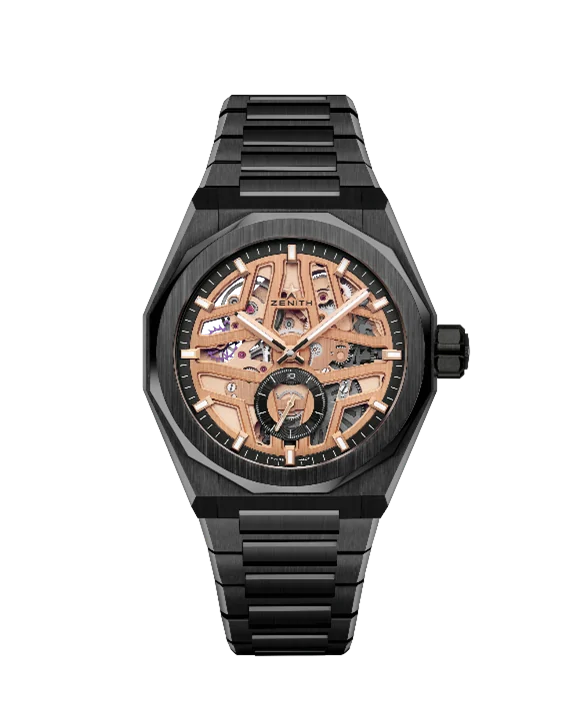
The moving assembly at six o’clock in the DEFY Zero G can be more compelling to watch than the seconds hand. This is Gravity Control, a gimbal that holds the regulating organ horizontally. Our subject is the titanium model from the 2018 generation, which brought the idea into DEFY’s open architecture.
The underlying principle comes from the suspension of marine chronometers. The case changes position while the inner assembly seeks to remain level. The construction aims to reduce positional rate errors. Zero G does not mean gravity disappears, nor does the name alone guarantee zero timing deviation.
 Enlarge
Gravity Control in the lower portion of the titanium DEFY Zero G’s open dial.
© Zenith · SourceThe El Primero 8812 S is manually wound and runs at 5 Hz, or 36,000 vibrations per hour. El Primero does not imply a chronograph here: this watch displays the time, small seconds and power reserve. Its lack of start buttons fits that purpose.
Practical meaning
Openworking reveals the layout without turning the watch over. Hours and minutes sit above, with small seconds to the left and power reserve to the right. Attention is divided between reading the time and observing the mechanism, trading familiar three-hand simplicity for mechanical spectacle.
The titanium case measures 44 mm across and 14.85 mm thick. Around 50 hours of reserve calls for regular hand winding. Trying the bracelet version on matters: diameter alone cannot tell you how this substantial open construction will sit on a particular wrist.
The strongest reason to study Zero G is the visible alternative approach to the regulator’s position. A collector buying an example should focus on service history and access to specialist support rather than treat the system’s name as a promise of perfect timekeeping. #Zenith #DefyZeroG #ElPrimero #GravityControl #ManualWinding #WatchMovement