MB&F · Legacy Machine Perpetual Stainless Steel
The movement in detail
The movement’s idea
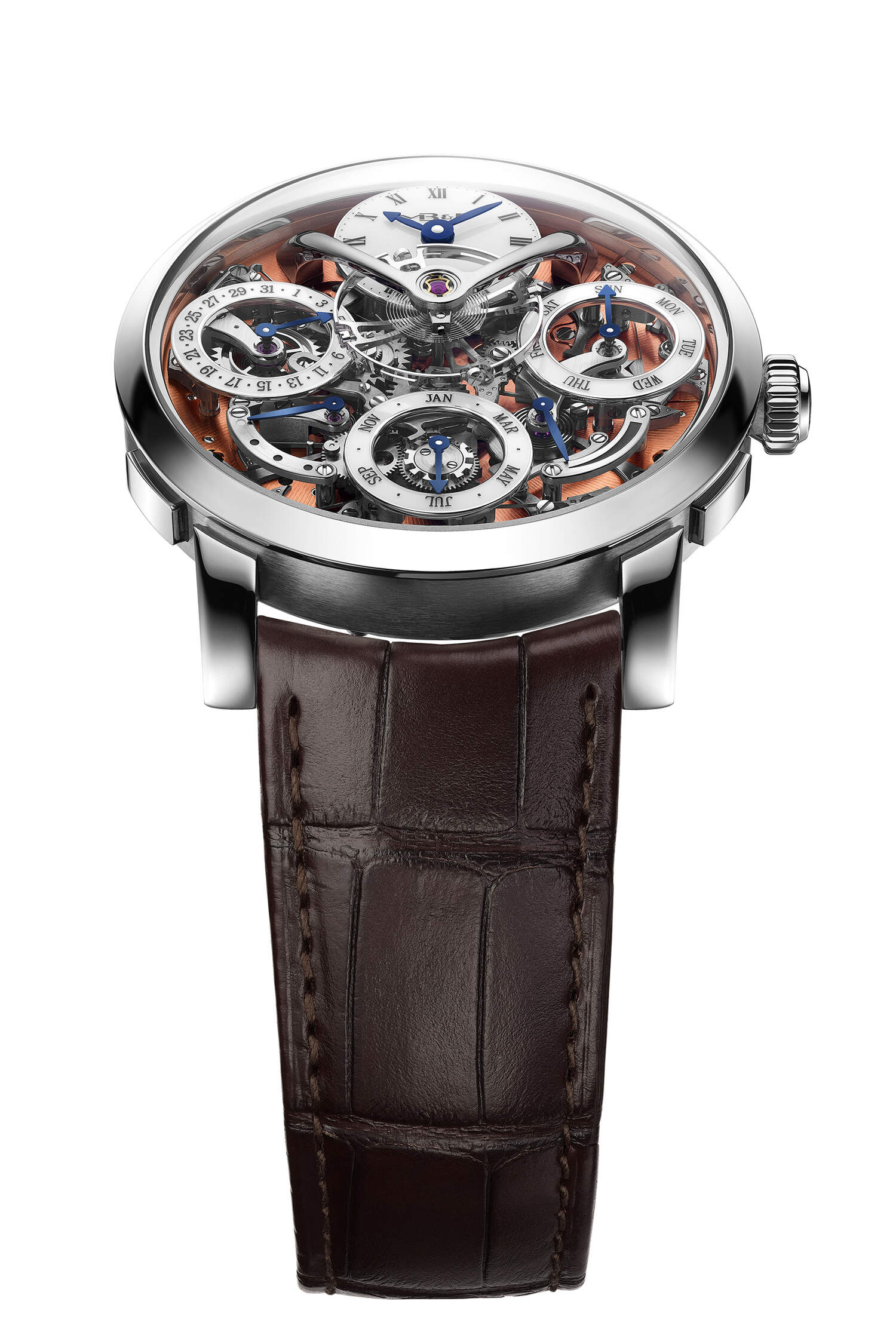
The unusual feature of the MB&F Legacy Machine Perpetual is the way it calculates the calendar. This examination focuses on the standard Stainless Steel version with a salmon-coloured plate, reference 03.SL.S, introduced in 2023. Its steel case surrounds an almost completely exposed movement: hours and minutes sit at the top, the date on the left, weekday on the right and month below. White ring-shaped scales and blue hands separate the information, although the official photographs make one thing clear: considerably more detail competes for attention than on a conventional calendar dial.
Stephen McDonnell developed an integrated movement with the calendar designed into its structure, rather than added as a module to an existing base calibre. His “mechanical processor” begins with 28 days, the minimum length shared by every month, and adds the days required. April needs two more, January three and February in a leap year one. Consequently, the transition to the next month does not require the indication to run through surplus dates. The important point is not the processor label but a different starting rule for mechanically establishing the correct month length.
The practical benefits become clear in the correctors. The year has its own setting button, removing the need to cycle through numerous months to select a position in the leap-year cycle. A safety system disconnects the correctors during certain changeovers. Protection against damage does not mean every setting operation works at every moment: the manual explicitly says the month and year correctors are inactive from the 25th until the end of the month. Certain corrections may also appear incorrect between 10pm and 2am. The manufacturer prohibits excessive force and tools: if a button is disabled, follow the instructions to leave the adjustment period rather than press harder.
Practical meaning
The three-dimensional appearance follows the architecture. A 14 mm balance sits above the calendar, while the escapement is on the back of the movement, connected by a long balance staff. Rather than flat decorative openworking, this construction has real levels: the balance bridge, individual scales, exposed wheels and salmon-coloured plate beneath them. The official close-up shows this depth, but cannot establish wrist-level legibility. Our reading of the layout is that this watch particularly suits someone who wants to observe a calendar mechanism, rather than simply obtain the date from it.
 Enlarge
The steel version with its salmon-coloured plate: the balance and calendar scales occupy different levels.
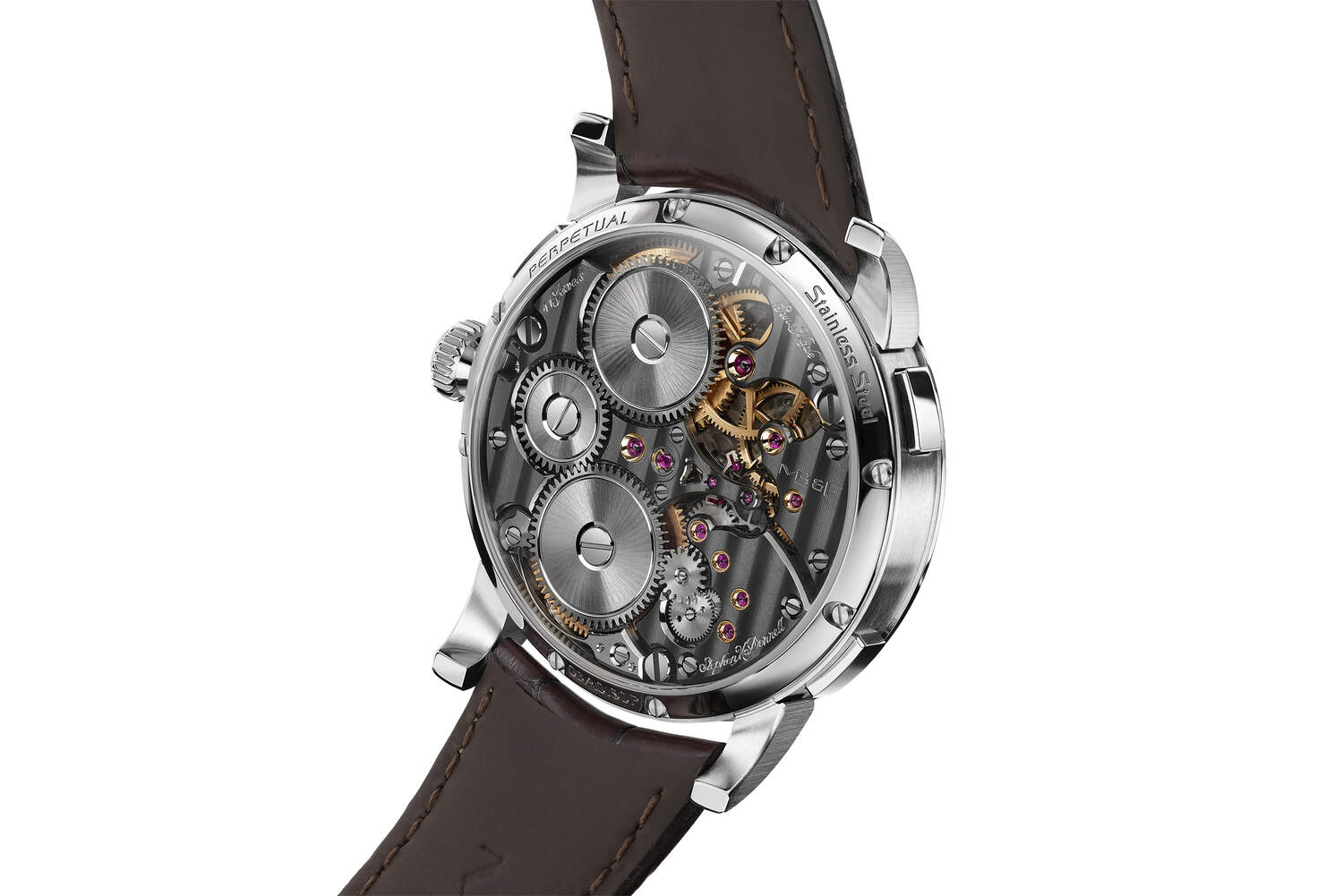
© MB&F · SourceThe hand-wound movement contains 581 components and 41 jewels, operates at 18,000 vibrations per hour, or 2.5 Hz, and draws power from two mainspring barrels. Its stated reserve is 72 hours, with an indicator that helps the owner keep the calendar running continuously. If the watch stops, its calendar will need to be brought back to the current date. Large wheels and traditionally finished bridges are visible through the back; MB&F specifies hand-finished bevels, internal angles, Geneva waves and hand engraving. Component count alone does not measure accuracy, and this article includes no independent rate measurements.
 Enlarge
The back of the same steel LM Perpetual: its hand-wound movement is visible through the sapphire back.
© MB&F · SourceA diameter of 44 mm and thickness of 17.5 mm give the LM Perpetual a substantial presence even without a precious-metal case. The steel version received more ergonomically shaped correctors previously used on the EVO, but its water-resistance rating remains 30 m, or 3 ATM. The other line’s sporting specifications must not be transferred to this watch. Sapphire crystals cover the front and back, with an alligator strap and steel folding clasp completing the case. This is an expressive perpetual calendar for an attentive owner: its architecture simplifies certain operations and protects the mechanism, without removing the need for winding, instructions and careful handling.