Jaeger-LeCoultre · Duometre Heliotourbillon Perpetual
The movement in detail
The movement’s idea
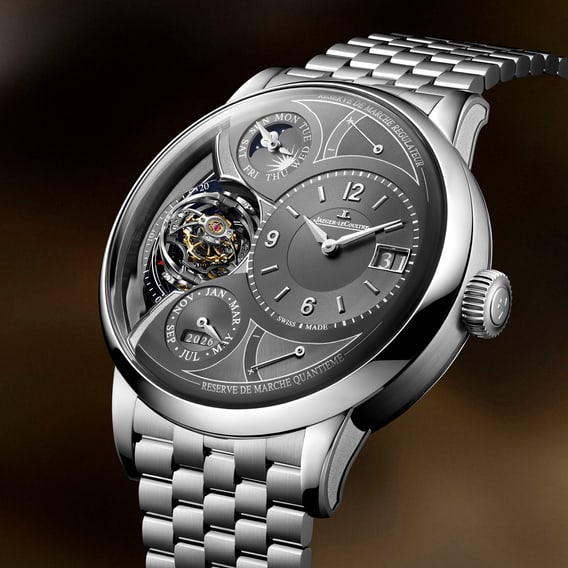
Three rotating cages give the Duometre Heliotourbillon Perpetual a motion that is fascinating even without knowing every complication. According to Jaeger-LeCoultre, the entire tourbillon assembly contains 163 components and weighs less than 0.7 g. Today we examine the platinum Q6206150 version introduced in May 2026. Its main attraction is calibre 388: it brings complex kinematics together with the Duometre system and a perpetual calendar.
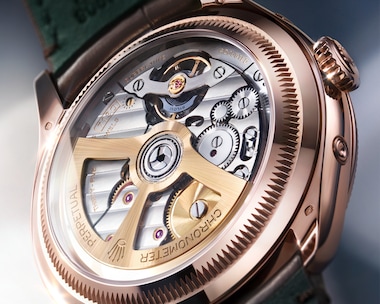
388 is an in-house, manually wound movement running at 4 Hz, with 655 components and 89 jewels. Its diameter is 34.3 mm and its height is 11.15 mm. The current official description states a 46-hour power reserve. That is an important reference for the owner: even a watch this complex needs regular winding. Two reserve scales on the dial show the state of the two energy circuits; they cannot be treated as an added total of running hours.
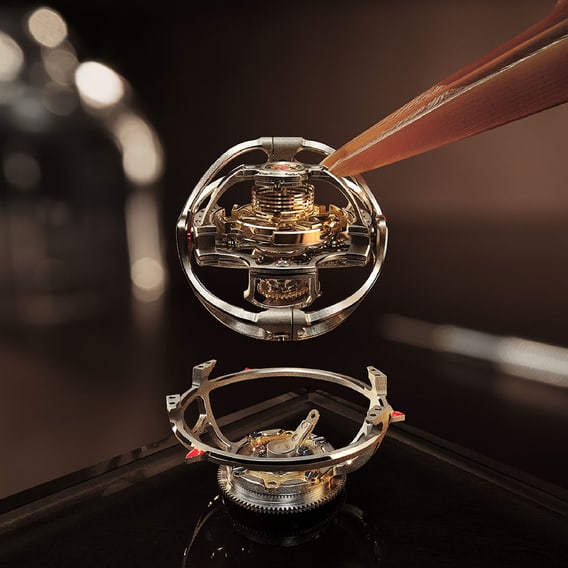
The Heliotourbillon uses a cylindrical hairspring, and its three cages are made of titanium. The first two complete a rotation in 30 seconds, the third in 60. The construction creates a spinning-top effect; ceramic ball-bearing supports are intended to reduce friction. The tourbillon changes the regulating assembly's orientation relative to gravity. The number of axes does not itself state a daily rate error, however: that requires measurement conditions and results for the individual example.
 Enlarge
An official Heliotourbillon assembly photograph: a close-up of the three-dimensional cages and cylindrical hairspring.
© © Jaeger-LeCoultre · SourcePractical meaning
The second interesting idea is Duometre, introduced by the brand in 2007. Two barrels and two separate gear trains connect to a single regulating organ. The purpose of this separation is to manage different energy demands inside a complicated watch. What interests me here is how the movement's work is organised: a collection of complications becomes an energy-distribution problem. Two barrels do not turn the stated 46 hours into 92, because they serve separate tasks.
 Enlarge
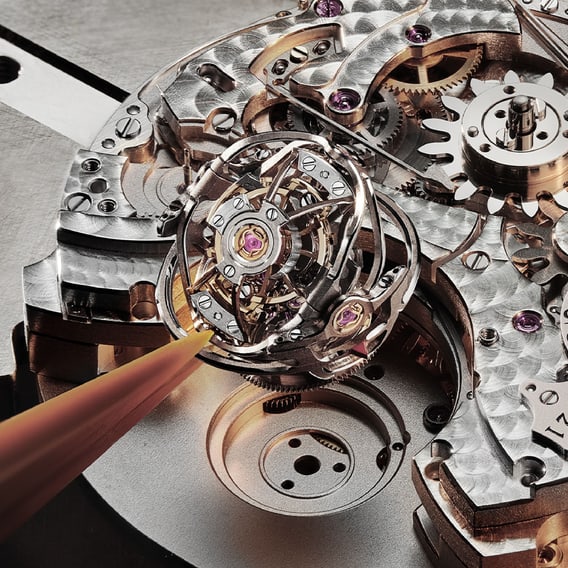
Installing the Heliotourbillon assembly into the movement. The manufacturing photograph shows the scale of the construction visible in full on the dial.
© © Jaeger-LeCoultre · SourceThe calendar occupies the calmer right-hand side of the dial. A large date sits at 3 o'clock, with the day, month, year and moon phases nearby. The year's final digit is highlighted in red during a leap year. The manufacturer specifies 122-year accuracy for the moon indication. That describes the lunar display's calculation, rather than promising that the watch can be worn for that long without servicing or any attention to setting.
The case and bracelet of this version are platinum 950; the case diameter is 44 mm. The five-row bracelet comprises 281 components and combines polishing with brushed finishing. These figures explain the construction's scale but cannot replace a fitting: the first links' fit, length adjustment and feeling of weight on the wrist matter. The official listing used here does not specify case height; the stated 11.15 mm refers to the movement.
The main practical tradeoff is a perpetual calendar paired with less than two days of reserve. If the watch is removed for a long time and stops, the calendar cannot know how many days have passed. Restore its indications according to the model's instructions. Before buying, I would ask for a demonstration of winding both circuits, the calendar-correction procedure and available servicing. Understanding the controls of expensive, complicated mechanics is more useful than one impressive close-up.
To my mind, Q6206150 is compelling as an object for observation and study. The dial reveals the regulator's motion, the calendar and the reserve state; the engineering idea is not entirely hidden under the caseback. The choice makes sense if you want this kind of mechanical spectacle and are prepared to monitor winding. Promising an accuracy advantage over every simpler watch solely from the tourbillon's construction would be wrong.