
Frederique Constant · FC-810 Monolithic / Slimline Monolithic Manufacture
The movement in detail
The movement’s idea
The familiar image of a watch movement is a balance swinging beside a fine hairspring. Monolithic offers another view. Frederique Constant’s automatic FC-810 uses a compact silicon oscillator with flexible elements. It runs at 40 Hz, or 288,000 vibrations per hour, ten times the 4 Hz common in mechanical watches. Here we examine the construction of an existing calibre, rather than a new launch.
The key element is made from monocrystalline silicon. According to the brand’s technical description, it is 9.8 mm in diameter and 0.3 mm thick, with the anchor integrated into the flexible construction. Movement comes from small deformations of compliant sections rather than the familiar large rotation of a balance wheel. Frederique Constant specifies a 6° amplitude and compares it with approximately 300° for an ordinary balance.
The idea grew from collaboration with Flexous. The manufacturer explains that the high frequency required a new base movement, FC-810: the conventional gear train had to be re-engineered. Four wheels rather than three sit between the barrel and escapement assembly. The innovation therefore cannot be reduced to replacing one small component: a suitable energy transmission system was built around the new regulator.
Practical meaning
At this frequency the calibre retains 80 hours of reserve. The brand connects that to the efficiency of the lightweight silicon regulator and reduced losses. In practical terms, it means more than three days of operation from a full wind. However, 40 Hz is not itself a daily timing-error figure. Assessing a particular watch’s accuracy requires its specifications and measurements; high frequency does not automatically make it more accurate than every other mechanical watch.
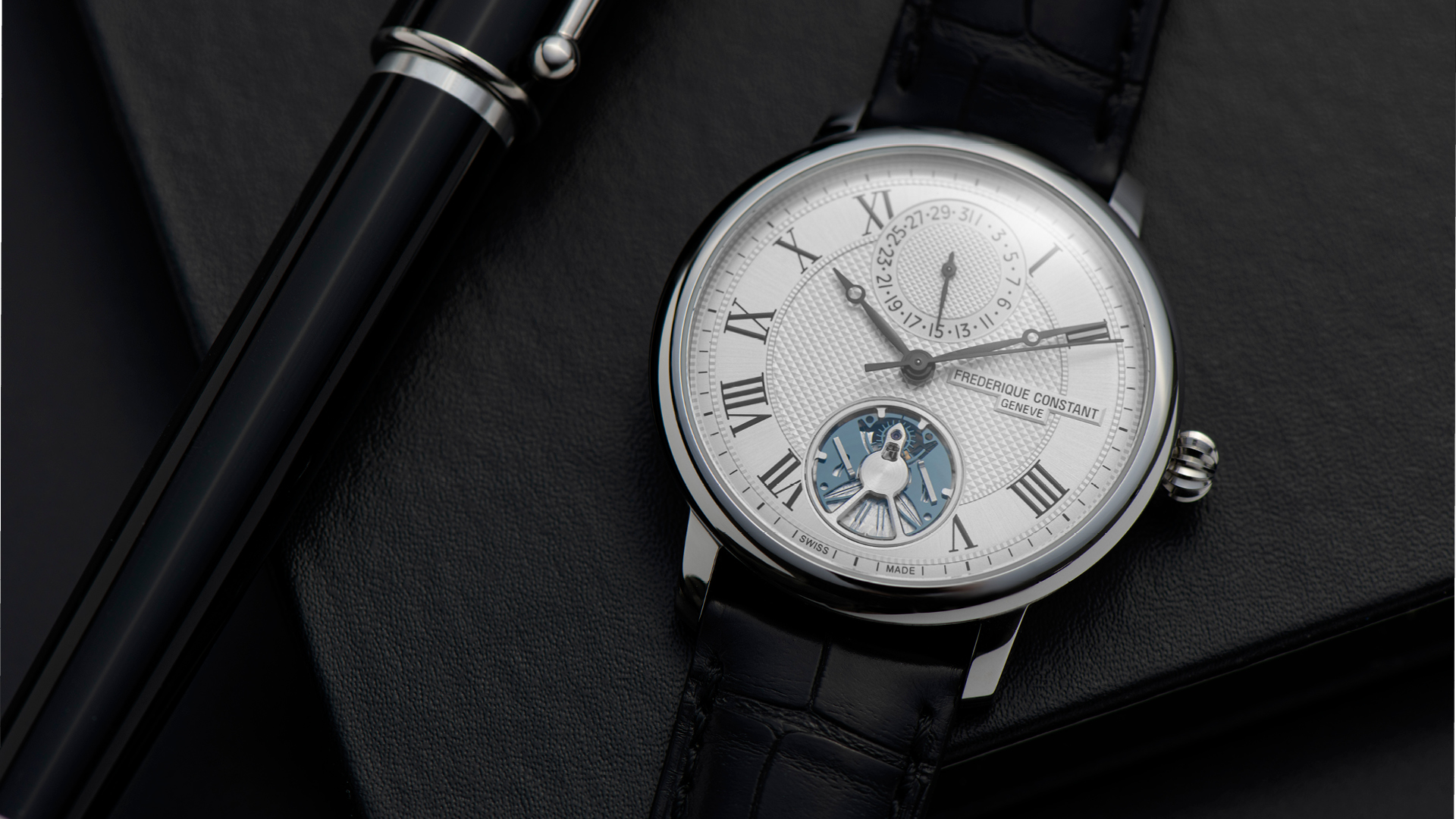
In Slimline Monolithic Manufacture, the technology sits in a classical 40 mm round case. Roman numerals and Breguet-style hands accompany an aperture at 6 revealing the oscillator. A pointer date occupies 12, and a transparent back exposes the automatic movement. I like the contrast: an outwardly quiet watch displays a construction quite unlike an ordinary Heart Beat.
 Enlarge
The Monolithic oscillator is visible through the aperture at 6, surrounded by a classical dial with Roman numerals.
© © Frederique Constant. · SourceFC-810 is interesting for a collector seeking diversity in mechanical construction itself. Before buying, confirm the specific version’s service options with an authorised workshop: this oscillator requires appropriate expertise and parts. The analysis is not tied to one commercial reference, so an old collection launch price is not substituted for current pricing or availability. The main reason to study Monolithic is the unusual regulating principle visible through the dial.