Atelier Mephalie · The Conductor
The movement in detail
The movement’s idea
Introduced in October, Atelier Mephalie’s The Conductor drew attention with a price of $25,000 before taxes, according to Monochrome. The function itself deserves more attention than a discount against Switzerland. What does someone pay for when they may not need to look at a dial at all?
In a conventional two-gong arrangement, hours sound in a low tone, quarters in pairs and remaining minutes in a high tone. This is the principle described by Patek Philippe. At 10:38, that means ten low strikes, two pairs for the half-hour and eight high strikes. This is an arithmetic example of the principle, not a recording of a particular Mephalie.
Audemars Piguet’s official page describes 720 possible sequences, one for each minute in a twelve-hour cycle. The parts have distinct roles: the hammer strikes and the gong sounds. Imagine a small instrument inside the watch, with the position of the hands determining its sequence.
 Enlarge
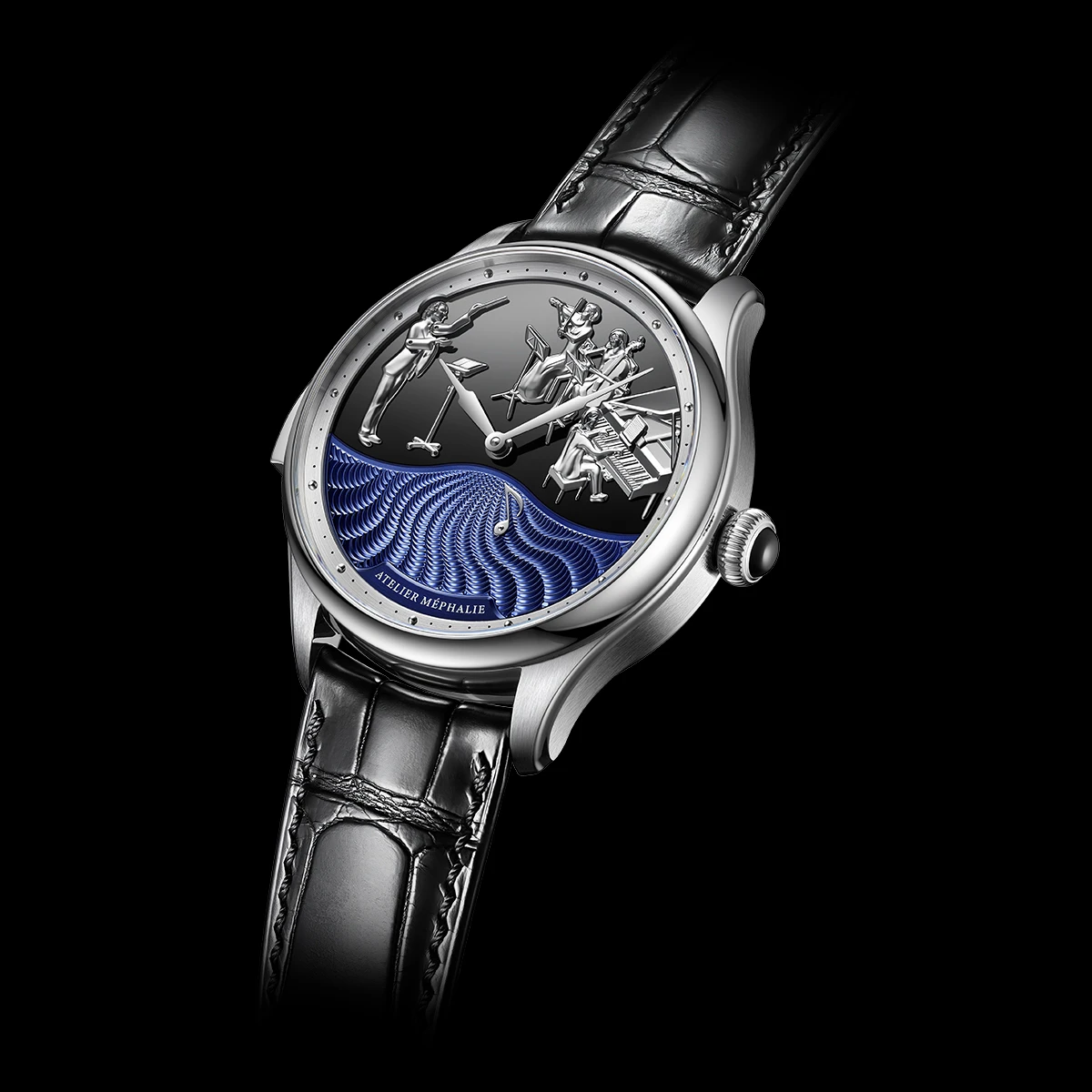
The Conductor: a close-up of the musicians and blue dial.
© Atelier Mephalie · SourcePractical meaning
A repeater alone does not promise an automatic chime every hour. It is activated on demand; a grande sonnerie can strike automatically. Thus minute repeater describes a way of communicating time, rather than an alarm or improved rate accuracy.
For Patek Philippe’s conventional two-gong repeater, the longest sequence occurs at 12:59: twelve hour strikes, three quarter pairs and fourteen minute strikes, making 32 in total. This is a useful listening exercise. Begin by counting groups, then try to identify the time without looking at the dial.
When comparing expensive chiming watches, I would ask to hear the actual example. Write down its displayed time and check whether the sequence is easy to follow. Discuss servicing separately: who accepts the watch, where work is performed and how its cost is agreed. For a rare function, these questions are more practical than a price comparison alone.
For Mephalie, we currently have the brand’s information published through specialist reporting. We have not independently listened to the watch, so cannot assess its tone, volume or adjustment. Nor can the construction of a particular Patek or AP be attributed to the Chinese calibre without documentation: the examples above explain the complication’s principle.