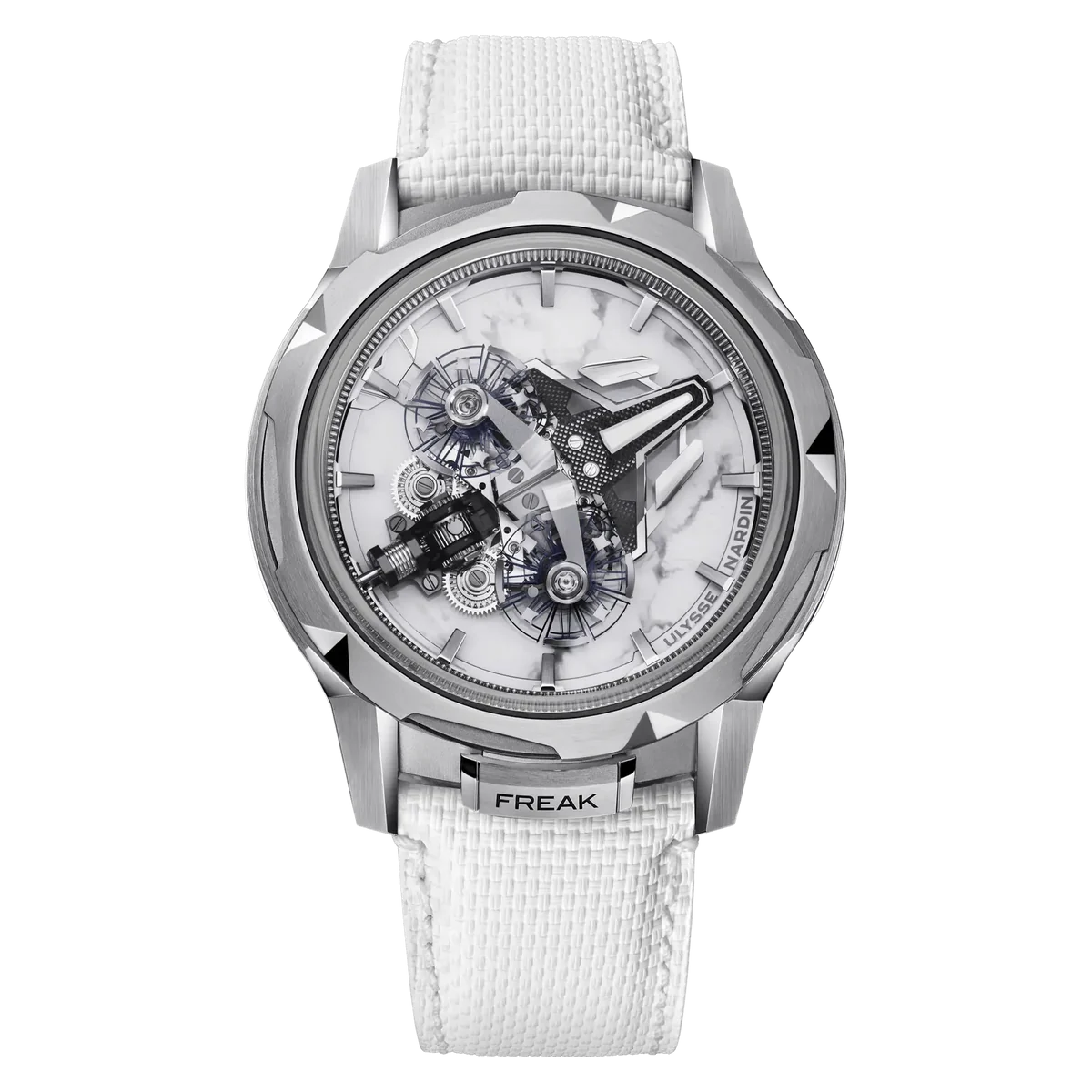
Ulysse Nardin · Blast Free Wheel Marquetry
The model in detail
Meet the watch
On the Blast Free Wheel Marquetry, your eye first catches individual wheels, then the blue geometric areas between them, and only afterwards finds the hands. That sequence explains the character of the watch: much of the pleasure comes from examining its construction. The official photograph shows how much space surrounds the mechanisms. For a collector who finds a conventional skeleton dial too crowded, this separated composition could be the decisive attraction.
The dial is assembled from 103 silicon fragments. The reason for choosing this treatment becomes clearer when examining the boundaries of the individual sections: the surface works as a mosaic rather than a uniform blue background. Mechanical complexity and decorative craftsmanship are not hidden on opposite sides of the case. They meet within a single field of view. It is an interesting way to discuss contemporary materials with someone normally drawn to enamel, engraving or other traditional forms of watch decoration.
 Enlarge
Working with the silicon dial: an official photograph of the assembly process.
© Ulysse Nardin · SourceThe impression of freely placed components should not be taken literally: the wheels remain parts of a connected mechanism. Visually, however, little of the familiar network of substantial bridges obscures the surface between them. This makes individual assemblies easier to distinguish, although reconstructing the entire energy path from a photograph is impossible. We see this architecture as an effective invitation to become interested in watch mechanics, rather than a teaching diagram with every connection exposed to the observer.
Details and limitations
The hand-wound UN-176 calibre operates at 2.5 Hz and features a flying tourbillon with Ulysse Anchor Constant Escapement. It is important not to turn the name of a sophisticated escapement into a promise of everyday accuracy: without measuring a particular example, we cannot say how many seconds it gains on the wrist. Its appeal to a buyer lies primarily in its unusual engineering. Comparing it with simpler watches solely by daily rate would overlook the main reason for taking an interest in this model.
The current manufacturer specification lists a 170-hour power reserve. The practical benefit is clear: a fully wound watch can be put aside for several days and worn again without resetting the time, provided its reserve has not run out. The indicator helps track remaining energy, although regular hand winding remains part of ownership. Extended autonomy is particularly useful in a collection of several watches, but by itself says nothing about rate consistency throughout the running period.
The white-gold case measures 45 mm across and 12.4 mm thick; stated water resistance is 30 m. Those figures set specific expectations: fit deserves a personal check, and the sporty appearance should not be treated as an invitation to water activities. The lack of conventional minute markings is also immediately visible in photographs. Trying it on should therefore include a straightforward time-reading check. For someone willing to trade instant legibility for an unusual mechanical composition, the compromise may be persuasive.