Grand Seiko · Kodo Constant-force Tourbillon
The movement in detail
The movement’s idea
The central drama of Grand Seiko Kodo SLGT003 unfolds at the bottom of the dial: two carriages rotate around one axis, but at different rhythms. Introduced on March 30, 2022, the watch received the manually wound 9ST1 calibre with a tourbillon and constant-force mechanism. This is an analysis of an established construction, not a 2026 debut. Its value is best considered through energy management: engineers combined two remedies for different sources of timing error, then made their operation visible. The open architecture helps explain the watch, although identifying the roles of every moving component at a glance is not straightforward.
The constant-force mechanism manages the supply of energy to the regulating assembly. As the mainspring unwinds, its available torque changes; this can alter balance amplitude and affect rate. In 9ST1, an intermediate remontoir spring periodically receives energy from the main train and feeds it to the tourbillon in small, repeating portions. The tourbillon has a different task: it rotates the balance and escapement components to average positional errors associated with gravity. These functions complement each other. The presence of both complications does not by itself prove that an individual example outperforms a well-regulated conventional watch: that conclusion requires comparable measurements.
The distinguishing feature of 9ST1 is its coaxial layout: the tourbillon carriage is nested inside the constant-force carriage. There is no intermediate gear train between the two assemblies, so its losses and variations in transmitted torque are not introduced. This does not mean that the entire movement is free of friction. The inner carriage completes a revolution in 60 seconds; the outer one advances in one-second steps. The balance operates at 4 Hz, or eight vibrations per second. The remontoir’s once-per-second impulse should not be confused with each escapement impulse: they are two different levels of the same process of supplying and metering energy.
 Enlarge
The open dial of SLGT003: hours and minutes above, the coaxial tourbillon and constant-force assembly below.
© Grand Seiko · SourcePractical meaning
The rhythm can be read without a separate central seconds hand. A ruby on one arm of the outer carriage serves as the small-seconds pointer. It advances in one-second steps while the inner assembly moves in much smaller escapement steps. The impression of smoothly rotating tourbillon motion therefore does not contradict the jumping seconds around it. The calibre also stops the carriage when the crown is pulled out, allowing precise time setting. This combination helps explain the construction: the observer sees more than rotating decoration, watching the constant-force mechanism’s one-second cycle coordinate with the balance’s faster rhythm. Kodo means “heartbeat”.
Two specification figures must be kept separate: the total power reserve is 72 hours, while the stated duration of constant-force operation is 50 hours. Three days of autonomy therefore does not mean three days of an identical energy-supply regime for the tourbillon. For an owner particularly interested in that regime, regular winding before the 50-hour interval expires is logical; this is a practical inference from the specifications, not a new accuracy guarantee. Grand Seiko specifies −3 to +5 seconds per day for 9ST1 within a 48-hour testing framework. Testing covers six positions and three temperatures, with the overall programme lasting 34 days. Each movement’s results are recorded in an individual certificate.
The calibre measures 35 mm across and 7.98 mm thick; the SLGT003 case is considerably larger at 43.8 mm across and 12.9 mm thick. Platinum 950 is combined with the proprietary Brilliant Hard Titanium, while a transparent caseback reveals another view of the construction. Stated water resistance is 10 bar. Those figures do not establish comfortable fit on every wrist in advance: the lug-to-lug span is 50.6 mm. When choosing, the complete case footprint deserves attention rather than diameter alone. The architecture of open bridges and carriages also takes some familiarisation when reading the time quickly from the small upper dial.
 Enlarge
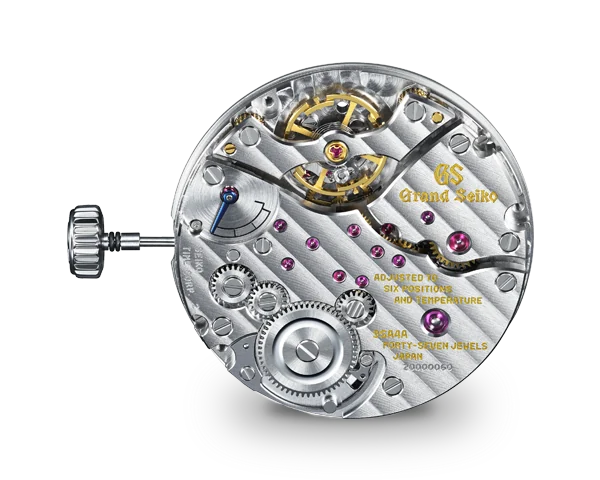
Calibre 9ST1 through the sapphire caseback: another view of the bridges, wheels and tourbillon assembly.
© Grand Seiko · SourceSLGT003 was limited to 20 examples. The checked official US boutique page displays USD 350,000 and asks visitors to inquire about availability. This is a displayed US-market price, not confirmed availability for purchase today or a secondary-market valuation. The same amount appeared in the American announcement in 2022. For a collector, Kodo’s significance lies chiefly in observable engineering: it is possible to follow how constant force and tourbillon work together and why they were integrated. For a buyer seeking only the smallest daily deviation, the specification does not promise a result proportional to such a high price.