Greubel Forsey · Nano Foudroyante
The movement in detail
The movement’s idea
The little red hand is the first thing I want to watch on the Nano Foudroyante; asking what it is for comes later. One revolution every second makes the mechanism look almost continuously in motion. Yet speed is not the main story: Greubel Forsey is investigating how little energy displaying it can consume. This analysis concerns the established 2025 collection version in white gold, limited to 22 pieces.
The word nano can sound like a promise of molecule-sized parts. Here it means something else: managing energy in nanojoules. According to the manufacturer, each foudroyante jump uses 16 nJ against 30 µJ for a conventional solution; the brand describes the improvement as approximately 1,800-fold. That applies to this mechanism, not the efficiency of the entire watch. Applying that ratio to total running time would be a mistake: the balance, tourbillon and chronograph still need their own share of energy.
Six jumps per second do not imply a high-frequency balance either. Its frequency is 3 Hz: three full oscillations produce six beats, and the hand divides the second into six parts. The engineering problem is repeatedly accelerating and stopping the indicator with minimal losses. Instead of a conventional foudroyante transmission, the brand uses a compact arrangement of low-inertia wheels. The interest therefore lies not just in low energy consumption, but in the approach itself: reduce the complication’s load first, rather than simply provide a more powerful energy source.
Practical meaning
The construction then becomes even more intriguing. The foudroyante sits inside a flying tourbillon that completes a revolution every minute. Its scale nevertheless stays aligned towards twelve, rather than asking the owner to mentally rotate the numerals with the cage. There are two different speeds here, plus a separate readability problem. In a photograph it is an attractive circle within an exposed mechanism; in motion, the point emerges from the combination of the fast hand, slowly rotating tourbillon and consistently oriented scale.
The spectacle must not, however, be mistaken for a stopwatch reading. The foudroyante runs continuously and separately from the chronograph: stopping a timing session does not freeze that little hand to display one sixth of a second. There is a separate flyback chronograph with a column wheel and a 60-minute counter. Flyback allows a running measurement to be reset and immediately restarted. That is useful for successive intervals, but six jumps and the practical accuracy of a manually timed measurement remain different things, even beneath the same crystal.
 Enlarge
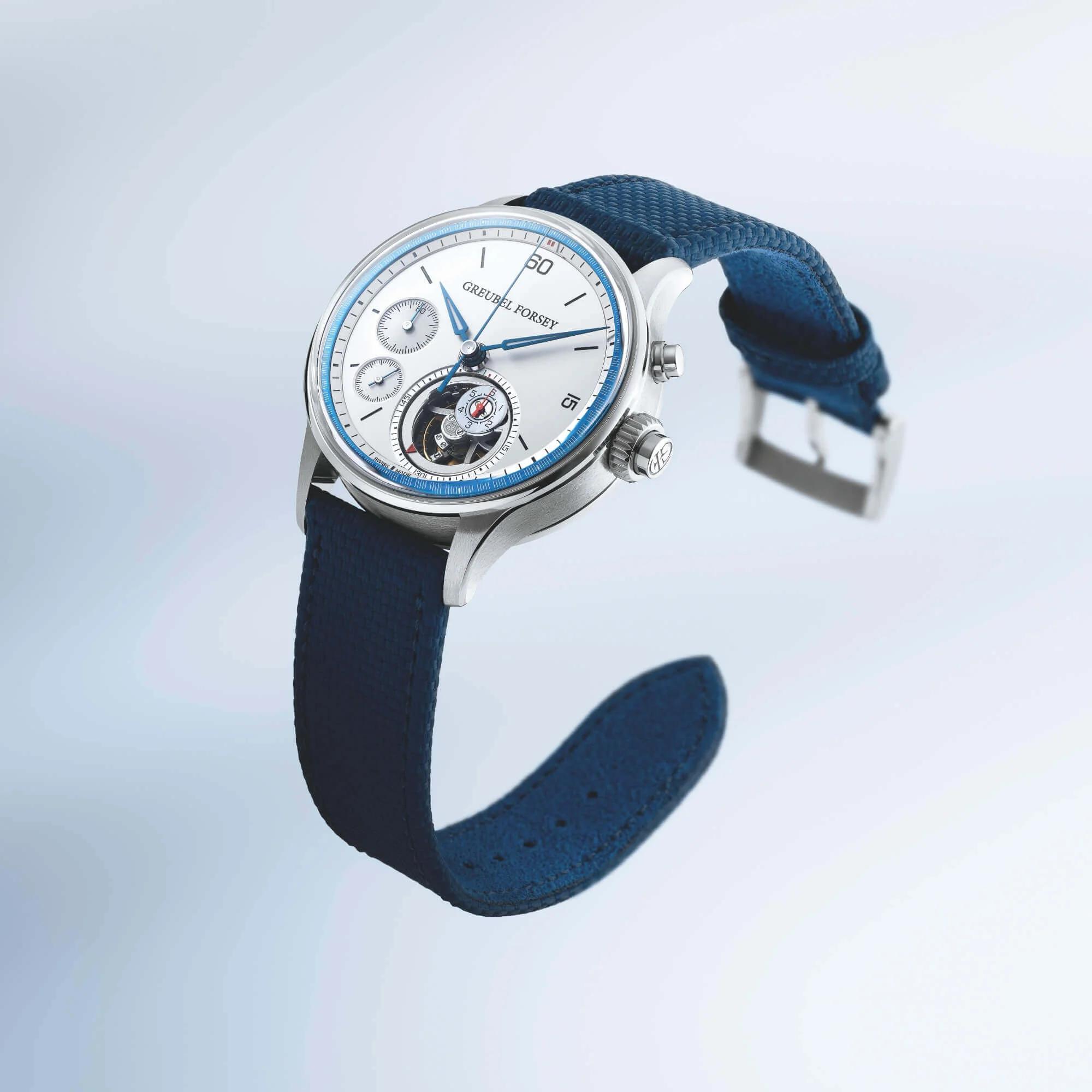
Rear view: the exposed manual-winding movement and controls on the white gold case flank.
© Greubel Forsey · SourceA 37.9 mm case makes this mechanism particularly interesting: complexity has not demanded an enormous dial. The movement contains 428 components, so simplification refers to a particular transmission, not the entire watch. The 22-piece version pairs white gold with blue accents and a blue strap. A small diameter does not promise a flat fit, however: Time and Watches clarifies that the quoted 10.49 mm case height becomes 14.34 mm including the domed sapphire crystals. That is a meaningful distinction for a shirt cuff.
 Enlarge
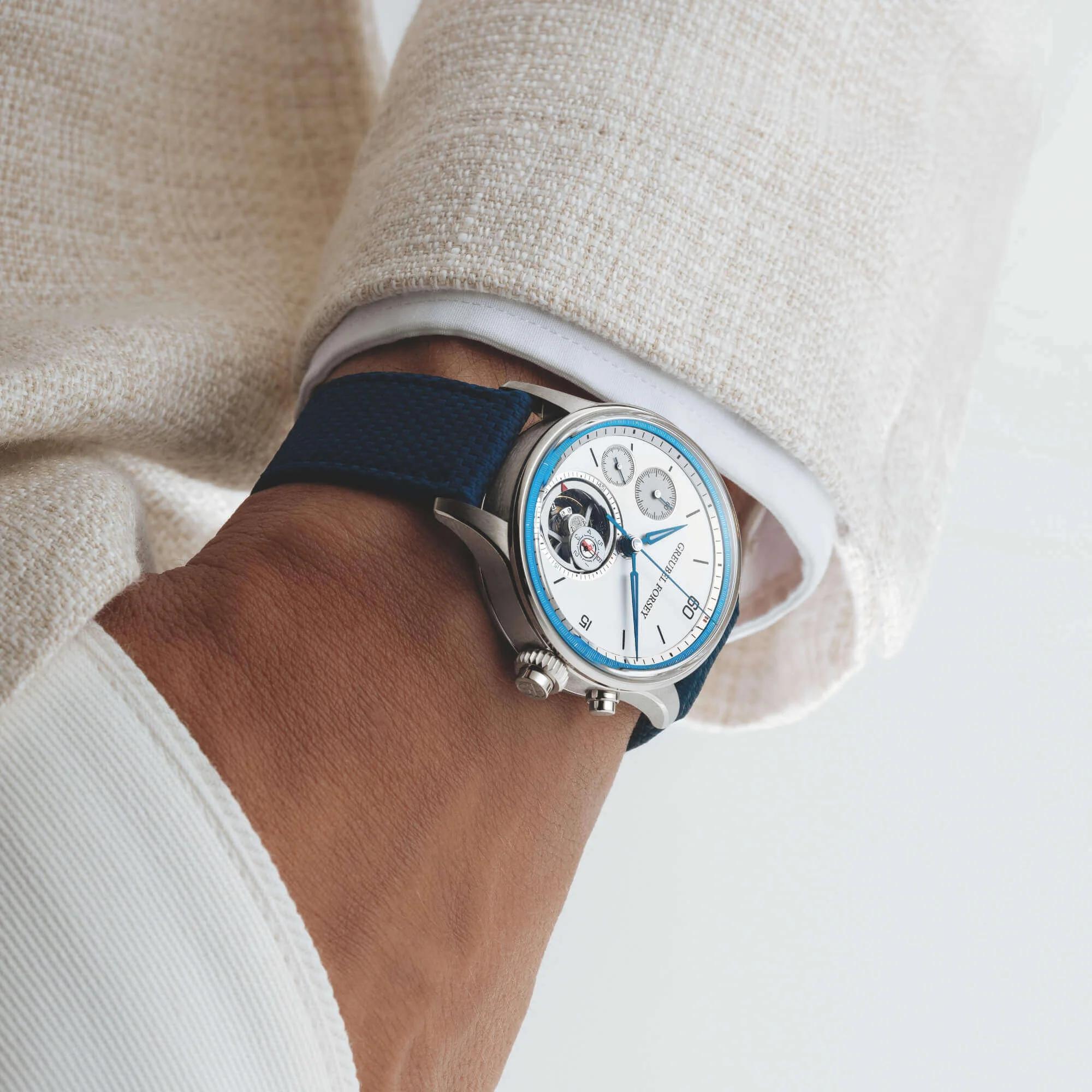
The official wrist photograph shows the blue-accented version.
© Greubel Forsey · SourceThe most sobering number alongside those nanojoules is a 24-hour power reserve, with SJX specifying that this is with the chronograph running. Manual winding means daily involvement, rather than leaving the watch over a weekend. Saving energy in one complication is not the same as giving the whole movement multi-day autonomy. Add the stated 30 metres of water resistance, and technical exotica does not make this an all-purpose sports instrument.
For me, the Nano Foudroyante is valuable because it changes the question we ask of complicated watches. Rather than how many more functions can be added, it asks how much energy one function actually needs. The constantly moving hand makes that question visible. But buying an idea and buying a convenient stopwatch are not the same: a prospective owner must accept daily winding, specialist servicing and the inability to stop the foudroyante alongside a measurement. As a demonstration of engineering thought, the watch is more persuasive than as a claim to everyday practicality.