
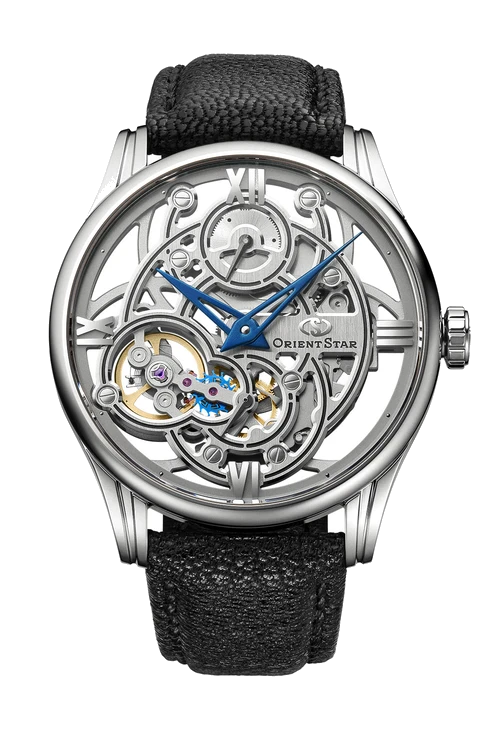
Orient Star · Skeleton 75th Anniversary
The movement in detail
The movement’s idea
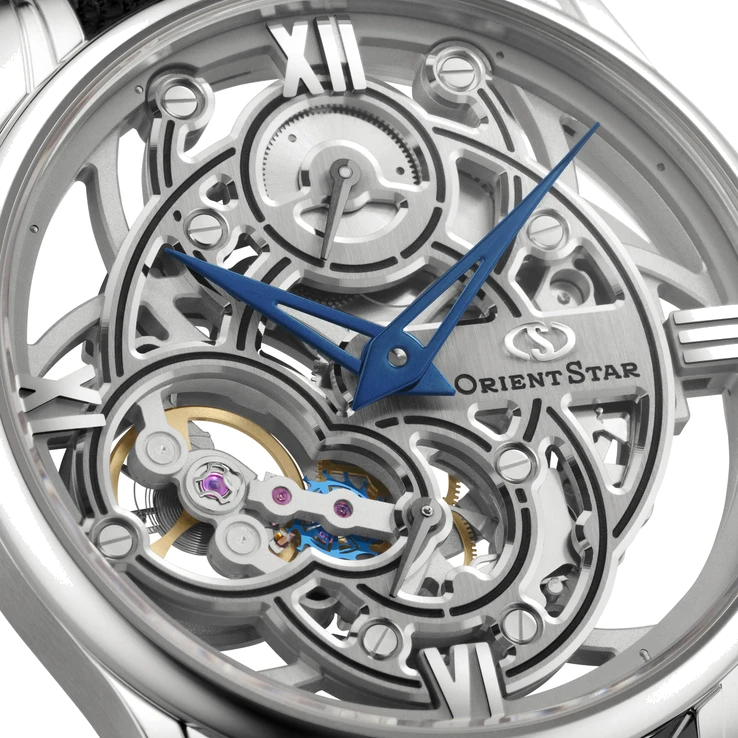
The balance of the Orient Star Skeleton RE-BR0001N sits in the lower-left part of the composition, surrounded by arcs that spread like ripples across water. More important than the metaphor is the way the new hand-wound F9B82 calibre creates that pattern: there is no conventional solid dial. Three overlapping levels of circles make the spaces between components part of the design. For a brand that has made skeleton watches since the Mon Bijou of 1991, the anniversary flagship is interesting for its fresh reading of a familiar idea: the movement becomes the main attraction from either side of the watch.
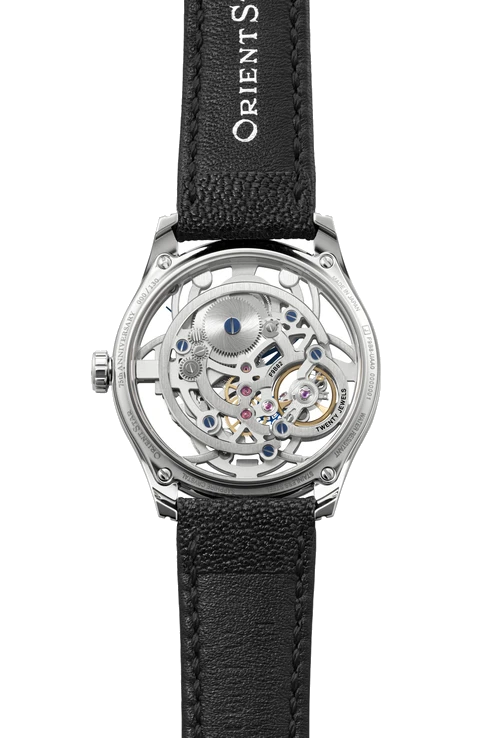
Hand winding has a clear visual advantage here. There is no automatic winding rotor to interrupt the view through the sapphire back. The gear train, bridges and balance remain exposed, although the bridges must still hold the component pivots in their intended positions: skeletonisation does not remove their mechanical responsibilities. F9B82 has 20 jewels, and the official F9B8-family manual for the BR model specifies a frequency of 21,600 vibrations per hour, or 3 Hz. Small seconds and a power-reserve indicator at 12 remain on the front, so the open construction has retained useful information.
 Enlarge
F9B82 in close-up: the balance at lower left, openworked blue hands and power-reserve indicator at 12.
© Orient Star / Seiko Epson Corporation · SourceOne of the key components in F9B82 is made from silicon: the escape wheel. Together with the pallet fork, it meters the release of energy from the mainspring rather than allowing the gear train to spin freely. In a technical interview about adopting silicon, Epson engineers explain the reasoning through the component’s lower mass and more precise geometry, which help reduce energy losses in the escapement. Production used MEMS technology familiar to the company from printheads. That experience helps explain Orient Star’s direction, but the published material does not allow every F9B82 characteristic to be attributed to one material: running time depends on the movement as a whole.
Practical meaning
The stated power reserve exceeds 72 hours. A full wind on Friday evening should therefore last until Monday morning, even if the watch spends the weekend on a shelf. The indicator at the top is more useful than a habit of counting crown turns: it shows the remaining reserve, although the manual cautions that it is a guide rather than a precise countdown. There is also an important difference from many automatic movements: the crown stops turning at full wind. Forcing it further can damage the mainspring or other components. Hand winding therefore calls for attention, although doing it every day is not necessary just to keep the watch running.
 Enlarge
Rear view: hand winding leaves F9B82 exposed, without an automatic winding rotor.
© Orient Star / Seiko Epson Corporation · SourceF9B82 has a stated daily rate of −4 to +10 seconds. The manufacturer specifies that this is static accuracy following factory adjustment at room temperature; watch position, temperature and the state of wind can change the result on the wrist. The manual recommends assessing the deviation over roughly a week rather than a single day. The three-day reserve should therefore be understood primarily as the freedom to wind less frequently, rather than a promise of identical performance at every point on the scale. A hacking function supports precise time setting: pulling out the crown stops the seconds hand.
The finishing helps make the structure itself legible. Mirror-bright bevels are diamond-cut, fine directional brushing is applied by hand, and black lines in recessed grooves emphasise the curves. The skeletonised blue hands and screws receive their colour through heat bluing. The pale surfaces consequently do not merge into a single reflective background: individual circles and different levels can be examined separately. Yet the time-telling hands are openworked too, and that raises a question of personal convenience. Before buying, check how quickly your own eye finds the slender minute hand among the exposed components.
All this depth fits inside a steel case 40 mm across and 9.5 mm thick, with a lug-to-lug length of 46.8 mm. That provides useful context for the dramatic frontal view: an enormous case was not needed to display the movement. The curved front sapphire has SAR coating, and the back is sapphire too. A black goatskin strap measures 20 mm wide and has a folding clasp. Water resistance, however, is limited to 3 bar: this slim skeleton on leather is best kept on dry land, with a different watch chosen for swimming.
The model was officially announced on 9 September 2026. The international RE-BR0001N listing schedules its launch for December; the Japanese version of the same anniversary model, designated RK-BR0001N, is planned for 10 December. Total production is 130 pieces. Orient Star also states a ten-year warranty and three complimentary overhauls during that period in its international materials. Eligibility in the country of purchase, any required paperwork and the service location should be confirmed with an official seller. For such a small series, that is a meaningful part of the decision: beyond enjoying an exposed movement, you want to know who will keep it running.

