Laurent Ferrier · FBN229.01 Micro-Rotor
The movement in detail
The movement’s idea
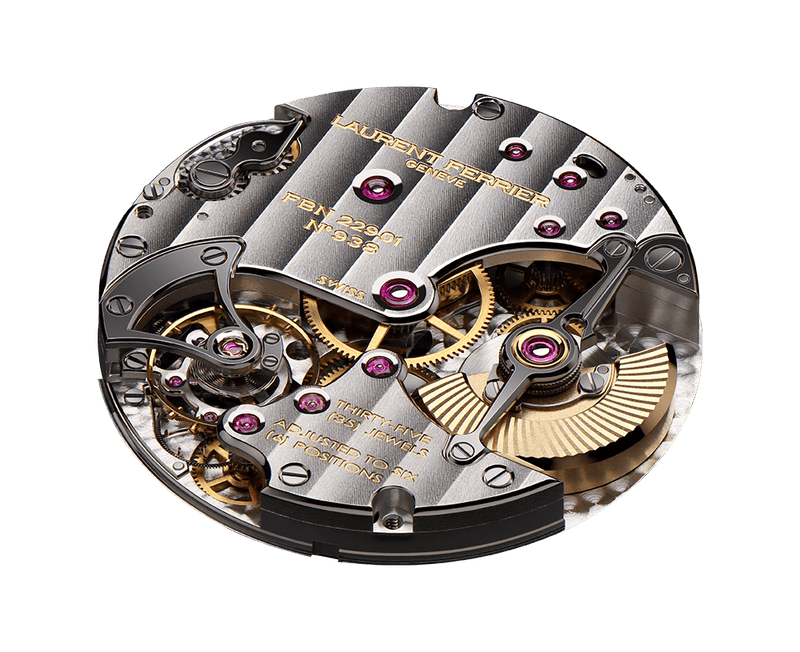
The most interesting part of this Laurent Ferrier is not on the dial. In the movement photograph, a small rotor occupies only part of the space, leaving bridges and balance in view. For a collector, this is an appealing compromise: automatic winding does not turn the entire back of the watch into one moving surface.
The small rotor poses an engineering problem as well as an aesthetic one. In its historical GPHG description of the Galet Micro-rotor, the brand explained the need to match compact winding with movement efficiency. The rotor is fixed between plate and bridge; its job is to supply the spring, not directly keep the hands moving. These are different links in the same chain.
 Enlarge
Historical Galet Micro-rotor from the GPHG 2011 archive; not the current Blue reference.
© Laurent Ferrier / GPHG · SourceAt the other end is a silicon double-direct-impulse escapement. The manufacturer’s 2023 Evergreen description specifies two escape wheels: the balance receives an impulse twice per complete oscillation. Here, double does not mean two time zones or twice the power reserve. It describes how energy reaches the regulator.
Practical meaning
The current FBN229.01 specification lists 3 Hz, a 72-hour reserve and a thickness of 4.35 mm. Three days are useful when alternating watches, but the nominal reserve assumes a fully wound movement. Automatic winding alone does not guarantee a full wind with every wearing pattern. Nor does a thin calibre automatically make the complete watch equally thin.
Finally, an unusual movement calls for thoughtful servicing. The manual recommends the brand’s workshop and a complete service roughly every four to five years, depending on use. Before buying, I would therefore establish not just the price of the watch, but its service route: where it goes, who accepts it and how the turnaround is estimated.