
Origins
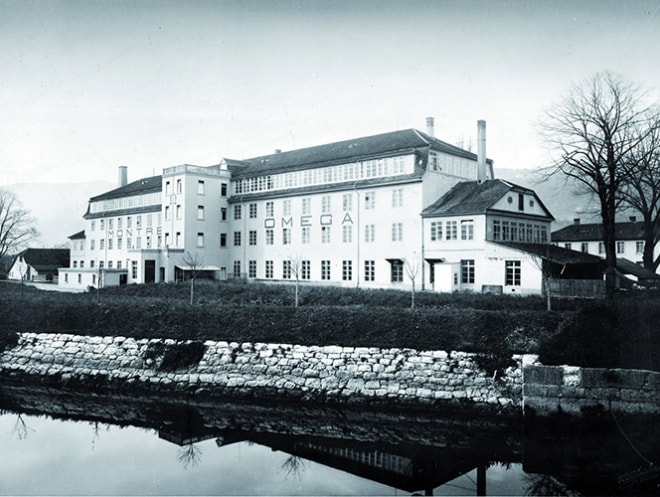
OMEGA has three different beginnings. The first is 1848, when watchmaker Louis Brandt established his business in Switzerland’s La Chaux-de-Fonds. The second is 1894, when a movement named Omega appeared. The third is 1903, when the company adopted that name. So “since 1848” refers to the enterprise’s origins, rather than suggesting that the familiar name was already on its earliest watches.
From family to manufacture
The founder’s sons, Louis-Paul and César Brandt, continued the business. They were responsible for the move towards industrial scale and the creation of the 19-ligne calibre in 1894. A ligne here is an old unit of movement size, not a count of jewels or components. The historical turning point was the combination of quality with the ability to produce movements in series: a good construction had to be repeatable from one example to the next.
The birth of a name
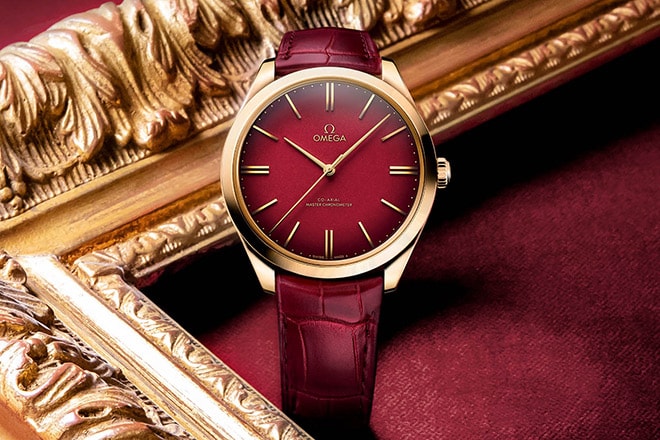
Why Omega? The final letter of the Greek alphabet, Ω, was intended to signify completion — a kind of final word in watchmaking. Initially, it was an ambitious name for a single calibre. Its success became so important that the name passed to the entire company in 1903. It is a rare instance of a movement literally giving a brand its name. The red De Ville Trésor in the photograph is the 2019 anniversary model celebrating 125 years of that name, not a nineteenth-century watch.
 Enlarge
De Ville Trésor, 2019: the anniversary watch celebrating 125 years of the OMEGA name.
© OMEGA SA / Swatch Group · SourceTiming the sporting world
The next major stage was sport. At Los Angeles in 1932, OMEGA became Official Timekeeper of the Olympic Games for the first time: one watchmaker and 30 precision stopwatches travelled from Bienne. Over time, manual result recording was supplemented by photo finishes, electronic sensors and data-processing systems. This is the less visible side of the brand: it does not simply sell watches, but also develops ways to measure sporting performance.
The journey to the Moon
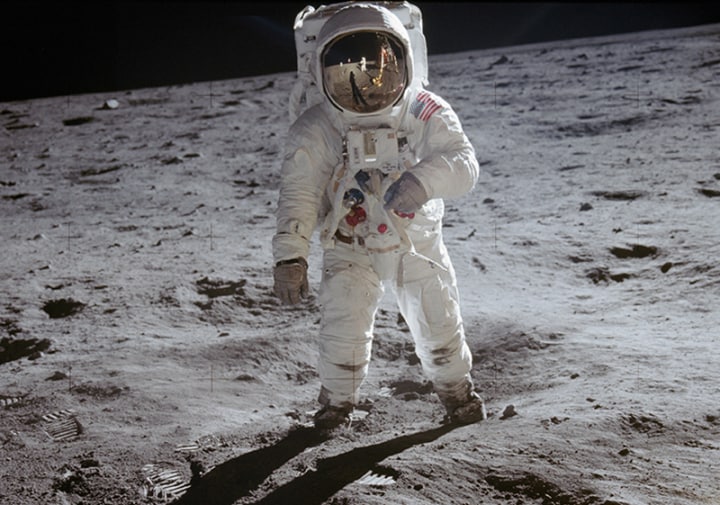
The post-war decades established familiar families: Seamaster, Constellation and then Speedmaster. The Seamaster appeared in 1948 and the Speedmaster in 1957; its future fame in space was not yet inevitable. Following NASA testing, the Speedmaster was qualified for crewed missions on 1 March 1965. In July 1969, the watch on Buzz Aldrin’s wrist reached the lunar surface. This was the achievement of a particular construction, not a certificate of spaceflight suitability for every watch bearing the OMEGA logo.
 Enlarge
Buzz Aldrin on the Moon, Apollo 11, July 1969. A historical NASA photograph reproduced in OMEGA’s account.
© NASA / Swatch Group · SourceA new idea inside
Another important chapter began in 1999: series-produced OMEGA watches with George Daniels’ co-axial escapement. An escapement is the assembly that meters mainspring energy and sustains the regulator’s oscillations. Once again, the brand’s story concerns the movement’s construction rather than merely the dial’s appearance. The invention belongs to Daniels; OMEGA’s achievement was bringing the idea into series production. Respecting that distinction is more interesting than reducing everything to the advertising word “innovation”.
Precision put to the test
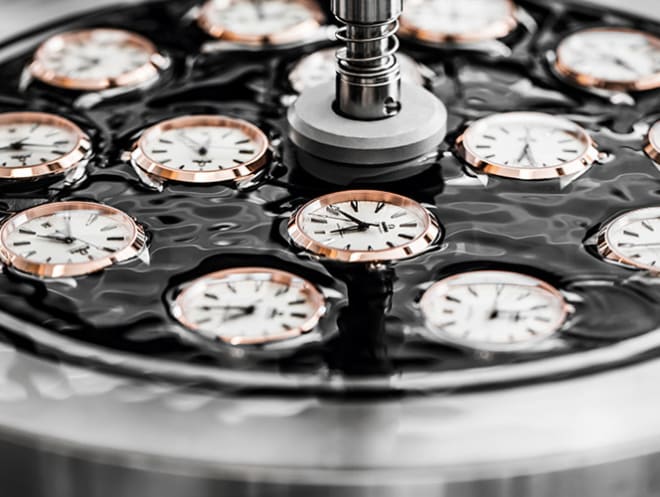
In 2015, the Globemaster became the brand’s first Master Chronometer-certified watch. The finished mechanical watch is tested, rather than just an individual calibre: accuracy, reserve, water resistance and operation after magnetic-field exposure up to 15,000 gauss are assessed under METAS requirements. METAS states an accuracy criterion of 0/+5 seconds per day on its website. These are standardised testing conditions, not a promise of identical results under every form of handling.
 Enlarge
Water-resistance testing at OMEGA: a photograph from the brand’s official gallery, with no capture date specified.
© OMEGA / Swatch Group; © OMEGA SA · SourceThe brand today
Today, OMEGA operates in Biel/Bienne and belongs to Swatch Group. Speedmaster, Seamaster, Constellation and De Ville tell different parts of the same story: space, water, precision and classical wristwatches. In the 178 years since its foundation, scale and tools have changed, but the original task remains connected: making mechanics whose results can be repeated and checked. When reading a brand’s history, it is useful to remember the individual watch too: its specifications are determined by its reference, not simply by the age of its logo.

