
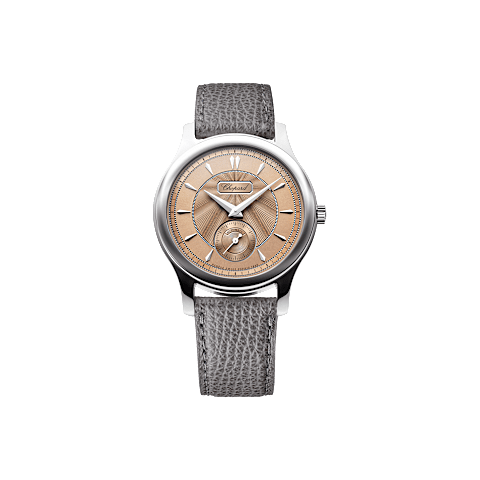
Chopard · L.U.C 1860 / Alpine Eagle 41
The movement in detail
The movement’s idea
After the dial duel, it is time to remove anonymity and examine the prices. On October 16, 2026, Chopard's US website lists the L.U.C 1860, reference 168860-3003, at $29,700 and the blue Alpine Eagle 41, reference 298600-3001, at $17,000. The difference is $12,700, approximately 74.7% of the Alpine Eagle's price. We compare one market and one currency; applicable taxes are added separately. These are the brand's retail offers, rather than completed secondary-market transactions.
The first obstacle to understanding expensive watches is treating them as quantities of metal and functions. Here, the smaller watch costs more, even though the other has a bracelet and date. A better question is which workmanship you want to see and which convenience you value. That moves the comparison beyond finding a winner by price.
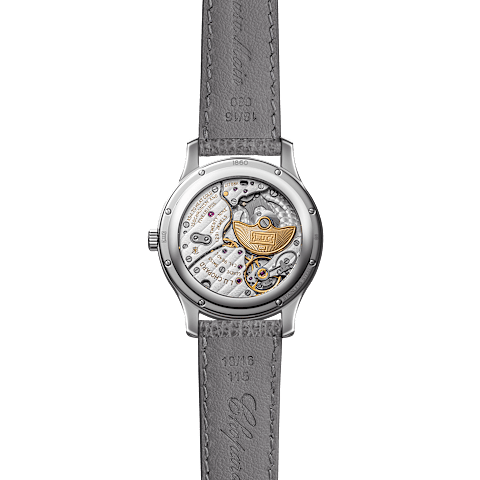
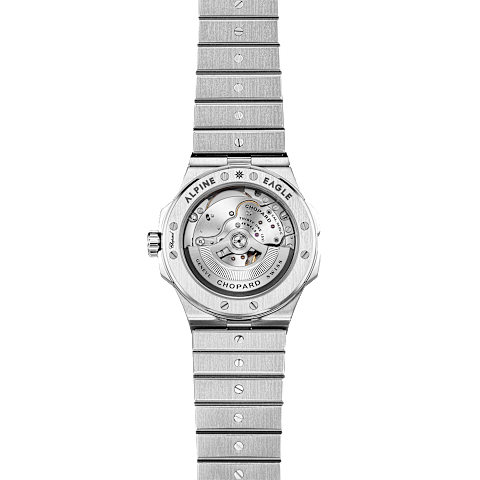
The main internal distinction is the slim L.U.C 96.40-L with a gold micro-rotor versus the Chopard 01.01-C with a central rotor. The micro-rotor occupies less of the view through the caseback. For a collector who enjoys studying bridges, that is a virtue in itself. Yet the winding layout alone proves nothing about superior accuracy, reliability or servicing costs. Equating unusual architecture with an unconditionally better watch would be too easy.
 Enlarge
L.U.C 1860: the micro-rotor leaves much of the bridgework on view.
© Chopard · SourcePractical meaning
The L.U.C has a gold dial base and hand-guilloché. These are tangible features to point to when discussing its higher price. The Alpine Eagle's blue radiating relief produces a different impression, more energetic and sporting. We would not call it less attractive: manufacturing technique and personal perceptions of beauty are separate criteria. To choose thoughtfully, study the pattern, the treatment of the markers and their relationship with the hands.
Both movements have COSC certification; the L.U.C additionally bears the Poinçon de Genève. The Geneva Seal specifies component finishing in detail, down to bevels, sides and flat surfaces. This is a substantial argument for a buyer who values execution under magnification. But the hallmark cannot be converted into a fixed dollar premium: it confirms compliance with requirements, rather than revealing a manufacturer's cost calculation.
The less expensive Alpine Eagle has a persuasive response: 100 metres of water resistance against the L.U.C's 30, a metal bracelet and a date. We see these as arguments for everyday versatility. The L.U.C offers a different setting: compact classical watchmaking on a strap. If you want one watch for most days, paying extra for slimmer mechanics may be less useful than the sports model's advantages.
 Enlarge
Alpine Eagle 41: the central rotor of the automatic 01.01-C.
© Chopard · SourceAn honest itemised breakdown of the $12,700 is impossible. Chopard does not disclose manufacturing costs, manual labour hours or margins for these models here. Retail prices also reflect collection positioning and commercial policy. We can identify differences between the products, but cannot prove that the entire gap equals additional production expense. Nor does it promise better resale performance.
Our criterion is straightforward: the L.U.C premium makes sense for someone whose eye repeatedly returns to the micro-rotor, guilloché and fine finishing. If an expressive sporting dial and daily convenience bring more pleasure, the Alpine Eagle needs no apology for its lower price. The substance of an expensive watch emerges in what its owner actually uses and enjoys looking at.
