Grönefeld · 1941 Remontoire Constant Force RG
The model in detail
Meet the watch
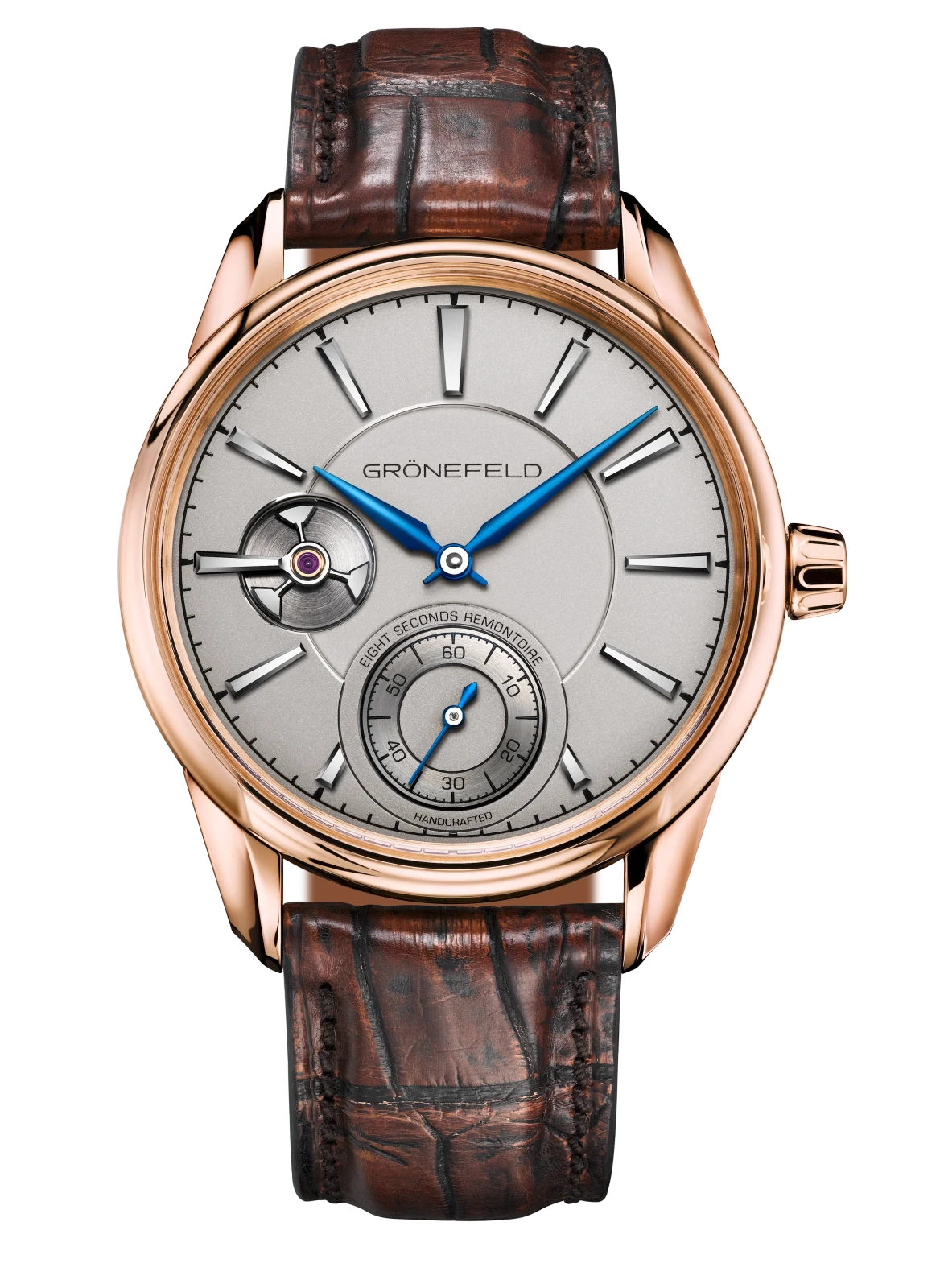
The Grönefeld 1941 Remontoire has a detail that rewards a longer look at the dial. The remontoire’s speed governor periodically comes alive in an aperture at nine o’clock. It belongs to an eight-second energy-delivery cycle, while the conventional small seconds hand sits below. The combination is unusual: time remains familiar to read, with the workings of a separate mechanism visible alongside it. In the red-gold version with a rhodium-coloured dial, this little performance sits particularly well with the quiet silver-toned surfaces and blue hands.
Think of the remontoire as a small intermediate energy store. As the main spring unwinds, the force it supplies changes. In G-05, a small spring works between the larger energy reserve and the escapement, and the mechanism rewinds it every eight seconds. That means 10,800 cycles a day, calculated simply by dividing the length of a day by eight. Its purpose is to reduce the effect of changing barrel torque on the balance’s oscillations. Stable energy delivery is built into the architecture, although the actual daily rate still depends on adjustment and operating conditions.
The selected model’s technical specification states 35 hours of power reserve with constant force. A stop mechanism intervenes when the operating range ends. For an owner, that is an important detail: the short reserve forms part of a construction focused on consistent operation. This watch calls for daily hand-winding. Put it down on Friday evening and it will need resetting before Monday. The seconds hand does stop when the hands are being set, making it easier to synchronise the display with an accurate time reference.
Details and limitations
G-05 itself comprises 258 components and 36 jewels. Its balance runs at 3 Hz, or 21,600 vibrations per hour, receiving impulses through a Swiss lever escapement. A free-sprung hairspring with a Phillips terminal overcoil and variable-inertia balance adjustment complement the energy-stabilising system. Here, the movement’s originality emerges from rethinking a familiar problem. The interest lies in how consistently the engineers control the force that ultimately reaches the regulating organ.
 Enlarge
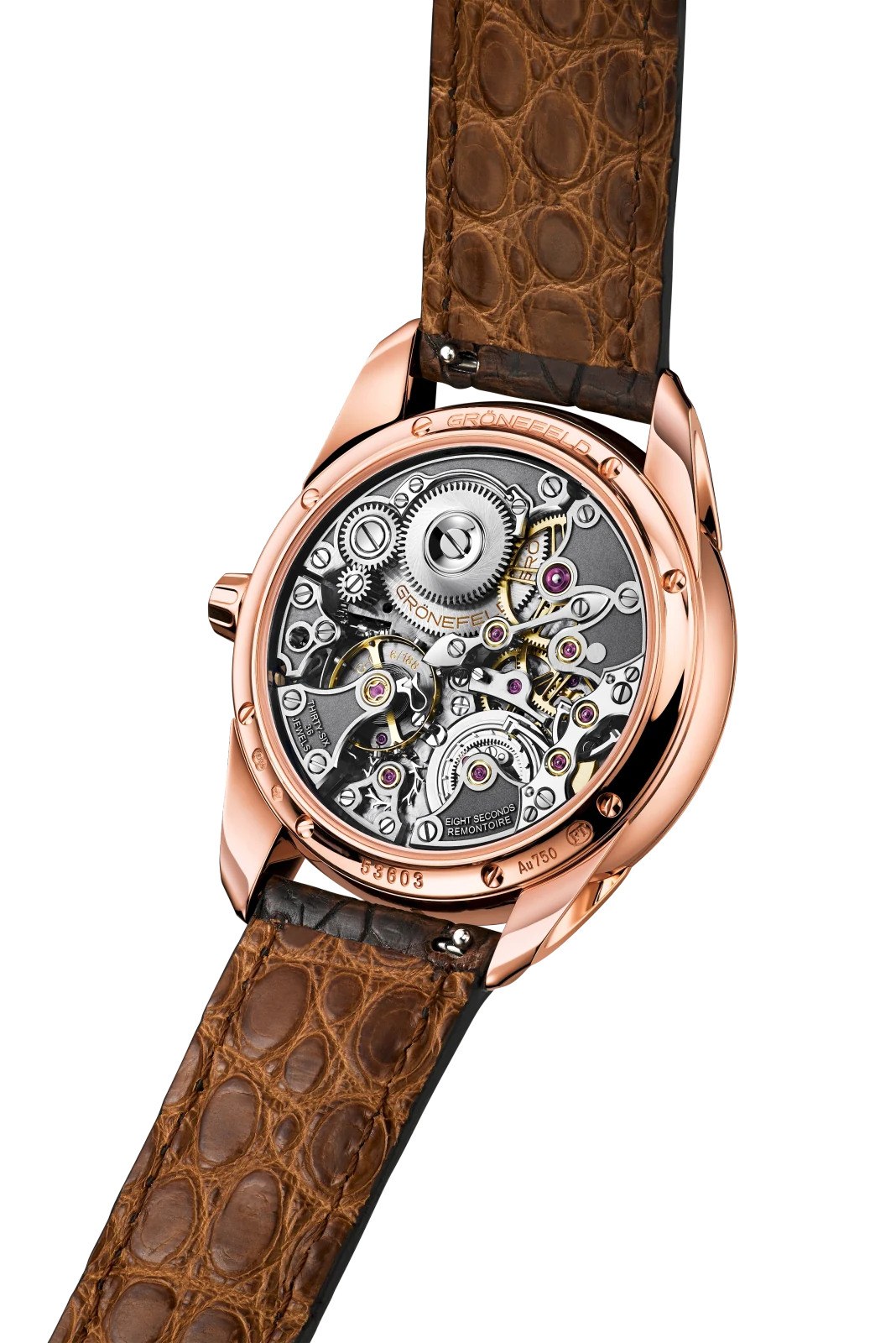
Calibre G-05 through the caseback: steel bridges, polished bevels and manual winding.
© © Grönefeld · SourceThe sapphire caseback reveals another reason to choose these watches. The bridges are made from stainless steel, with outlines recalling the shaped gables of Dutch houses. Matte central surfaces, hand-polished bevels and gold chatons create several levels of reflection. This architecture rewards examining one area at a time: each bridge defines its own part of the movement, with finishing emphasising the boundaries. According to Grönefeld, finishing, assembling and adjusting a single movement alone require at least 220 hours.
The case measures 39.5 mm across and 10.5 mm thick. Those are restrained dimensions for such an involved movement, preserving the proportions of a classical three-hand watch. The version considered here uses 5N red gold, a dial based on sterling silver and an alligator strap. Comfort cannot be inferred from diameter alone, however: lug shape and strap thickness still deserve assessment on your own wrist. The official photographs clearly show the flowing transitions from the case into its lugs.
 Enlarge
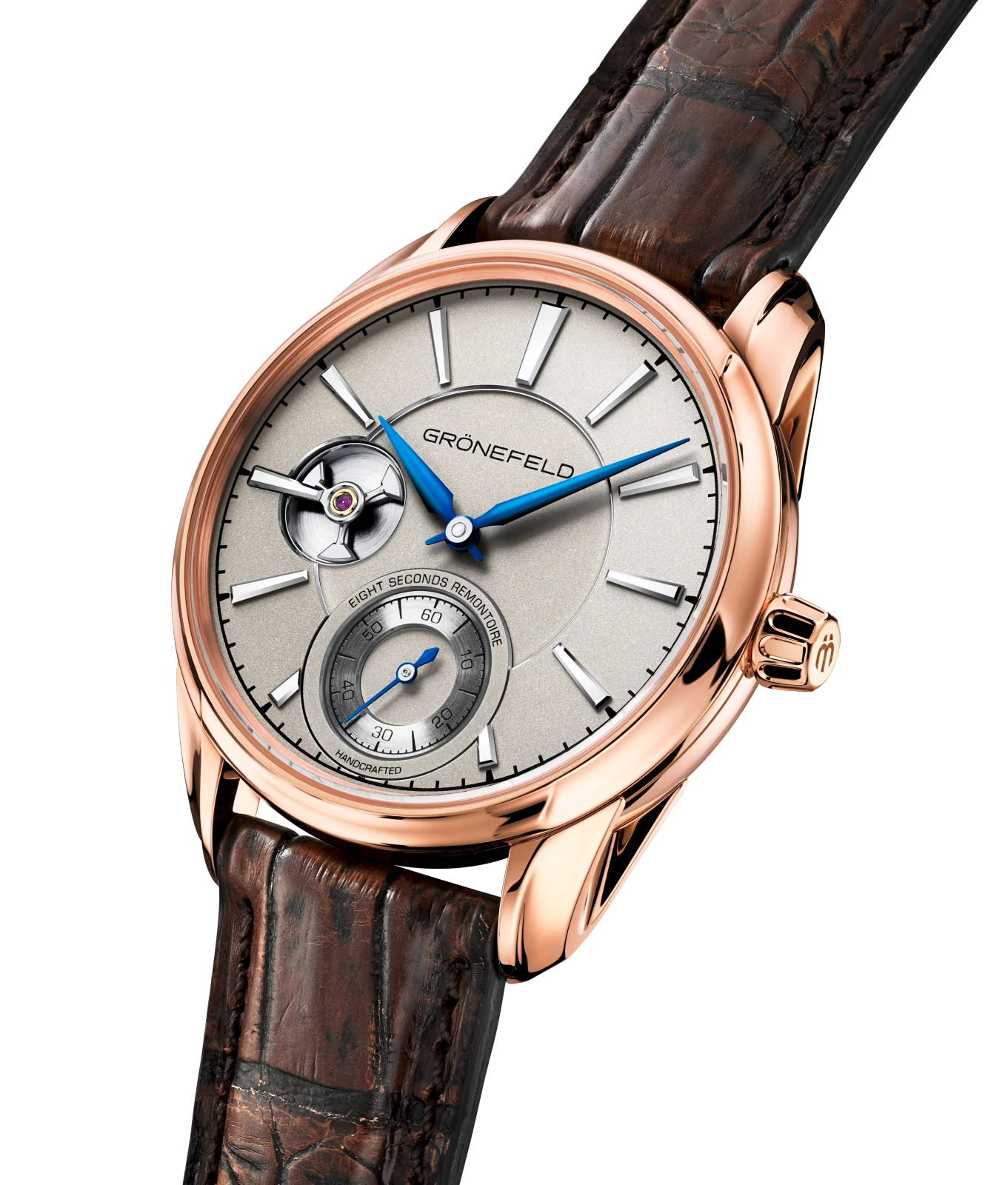
The red-gold case measures 39.5 × 10.5 mm. The remontoire governor is visible through the aperture at nine o’clock.
© © Grönefeld · SourceThe model occupies a definite place in independent-watchmaking history. It appeared in 2016 and won that year’s GPHG Men’s Watch Prize. Bart and Tim Grönefeld connect its inspiration to the tower clock at Saint Plechelmus Church in Oldenzaal, maintained by their grandfather and father. The wristwatch’s production programme was limited to 188 Remontoire movements, shared across case and dial variations. Its rarity therefore concerns the whole G-05 family, rather than a separate run of 188 for every colour.
Its practical limitations are clear: 30 metres of water resistance, a leather strap and frequent winding. At the time of checking, the manufacturer also stated that it was unable to accept new orders because of demand and limited production capacity. Finding a particular example therefore starts with checking availability and service history. We selected the 1941 Remontoire for the clarity of its engineering idea: the everyday problem of consistent running becomes a visible, carefully finished mechanism.