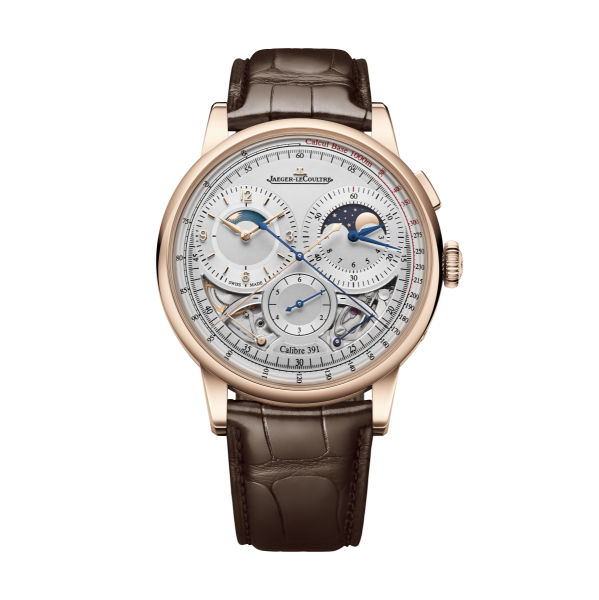
Jaeger-LeCoultre · Duometre Chronograph Moon Pink Gold
The movement in detail
The movement’s idea
The two power-reserve indicators on the Duometre have a practical purpose. One belongs to the current time, the other to the chronograph. You can compare them directly on the dial: a useful clue that two different energy circuits operate inside.
Calibre 391 uses two barrels and independent gear trains linked to one regulating organ. This architecture is intended to prevent the chronograph from consuming the timekeeping energy reserve. There is no second independent balance.
The official instructions clarify an important detail: the moon phase and day/night display draw power alongside the main time indications. The separate barrel serves the chronograph. Turning the crown in opposite directions winds these springs; both reserve indicators deserve individual attention.
Practical meaning
When the chronograph runs, the small hand at six o’clock completes one revolution per second in six steps. It allows sixths of a second to be read. However, display resolution alone cannot remove the delay in a human reaction when pressing the button.
Through the case back, no rotor conceals the manually wound mechanism. The official photograph reveals wheels and the intricate pattern of bridges. The 42.5 × 14.2 mm case calls for a fitting: thickness, not just diameter, determines how naturally this mechanism sits on a wrist.
 Enlarge
Calibre 391 beneath the sapphire back of Q622252J. Manual winding leaves the mechanism open to view.
© Jaeger-LeCoultre · Source#JaegerLeCoultre #Duometre #Calibre391 #Chronograph #ManualWinding #HauteHorlogerie