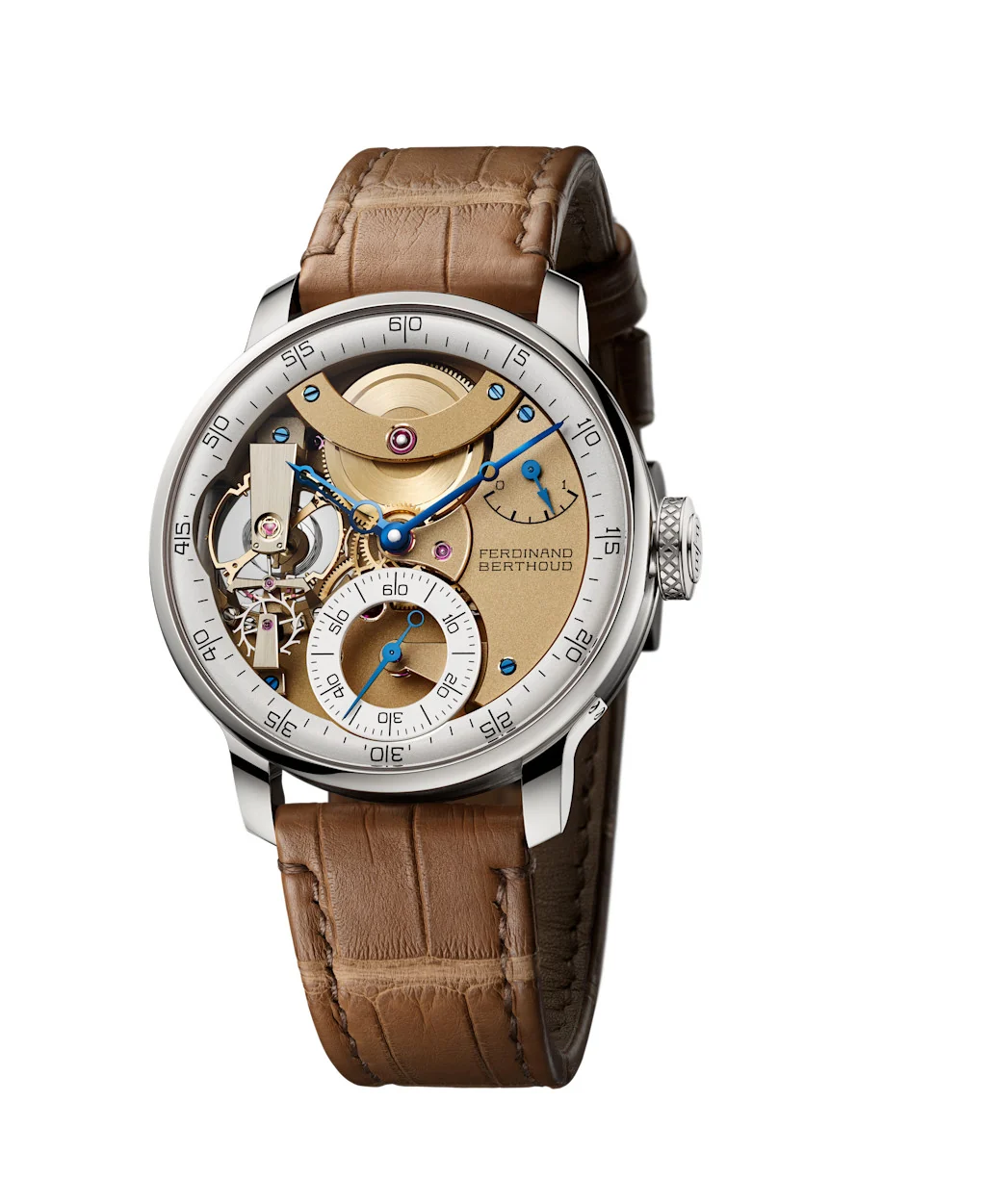
Ferdinand Berthoud · Chronomètre FB 2RE.2
The movement in detail
The movement’s idea
The seconds hand takes a clear step, then pauses. In the Ferdinand Berthoud FB 2RE.2, mechanics create this rhythm: the model introduced in 2020 has a one-second remontoir. This small intermediate energy store is replenished regularly by the main movement. On the black enamel dial, the result looks far calmer than the machinery beneath the rear crystal.
Why put another store of energy between the mainspring and the regulator? As a mainspring unwinds, its torque changes. A watch needs not only enough energy, but also a sufficiently even supply. Running time and rate stability therefore answer different questions: how long a movement runs, and how consistently it runs during that period.
The first equalising task falls to the fusee: a chain links the barrel to a conical element, changing the effective lever arm as the winding runs down. The remontoir then smooths smaller variations arising farther along the transmission. The two devices do not simply duplicate one function: they operate at different points in the energy path. Understanding that sequence is more interesting than counting complications.
 Enlarge
Rear view: the FB-RE.FC architecture and blue power-reserve hand.
© Ferdinand Berthoud · SourcePractical meaning
The remontoir's one-second cycle is linked to the central hand's discrete steps. Meanwhile, the balance continues oscillating at 2.5 Hz. It is a useful example of why a hand's visible motion alone does not identify the movement type. Stop-seconds allows precise time setting; the remaining power is indicated on the reverse.
The stated 50 hours deliberately restrict the mainspring's operating range. The manufacturer explains that the movement stops before all available energy is exhausted, avoiding a less favourable part of the range. Its testing report also describes COSC and Fleuritest results. These are the manufacturer's reports on the tested mechanism, not a promise of identical daily deviation on every wrist.
The exterior speaks an almost opposite language: rose gold, black enamel and conventional central hours and minutes. A side window reveals the chain without turning the watch over. But the technical sheet's 44 mm diameter and 14.30 mm thickness call for a fitting: visual restraint does not mean compact dimensions. Nor does the stated 30 m water resistance make this a sports watch.
This calibre rewards study as a lesson in energy management, and the watch is a collector's object made in ten examples. A buyer should prioritise the condition of the individual watch and servicing arrangements over comparing its reserve with a mainstream automatic. For readers, the key lesson is simple: a jumping seconds hand can reveal elaborate mechanics rather than a battery.