Ferdinand Berthoud · Chronomètre FB 3SPC.1
The movement in detail
The movement’s idea
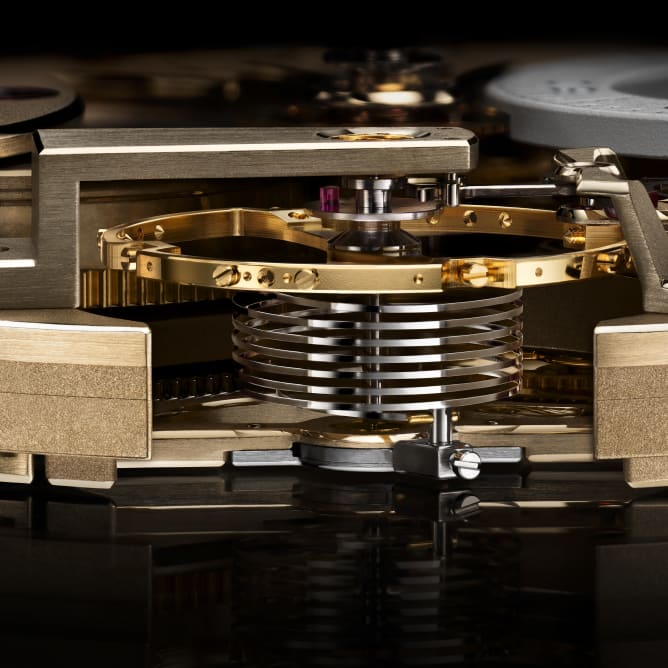
The FB 3SPC.1 is fascinating from the side. A sapphire window at 9 o'clock reveals the cylindrical hairspring — its coils sit above one another instead of spreading into a flat spiral. That is one reason to return to a model introduced on October 19, 2022. This feature covers the white-gold version with golden movement components: its FB 3SPC.1 designation should not be confused with later colour executions.
Together with the balance, the hairspring sets a mechanical watch's rhythm. A cylindrical shape has the potential to expand and contract around a stable centre; this 'breathing' interested the creators of marine chronometers. A wristwatch constantly changes orientation, however. Ferdinand Berthoud explains that this hairspring's mass and geometry can increase rate error in vertical positions. An attractive three-dimensional shape is therefore insufficient — it must be adapted to the actual conditions of a wristwatch movement.
The technical work here focuses on terminal-curve geometry, hairspring attachment and the variable-inertia balance. According to the manufacture, lightening the attachment assembly required revisiting the hairspring geometry, rather than simply fitting a historical component into a modern case. The outcome was the FB-SPC calibre with COSC chronometer certification. For the buyer, that is significant evidence of regulation. It does not replace measuring the particular watch's rate after purchase and on your own wrist.
 Enlarge
The FB-SPC cylindrical hairspring: its coils are stacked vertically. The close-up reveals its three-dimensional form.
© © Chronométrie Ferdinand Berthoud · SourcePractical meaning
FB-SPC is manually wound, runs at 3 Hz and has a stated 72-hour reserve. Its construction contains 230 components and 47 jewels. Three days of autonomy are convenient for rotating watches: with a full wind, the 60-hour break from Friday at 20:00 to Monday at 08:00 leaves a calculated 12 hours. This is arithmetic based on the stated reserve, not our measurement. The dial indicator lets you monitor the state of wind without guessing from the last time you wore it.
The case measures 42.3 mm across and 9.43 mm thick and is made of 18-carat white gold. The movement itself is 34 mm in diameter and 6.84 mm high. The difference is a reminder that calibre thickness is not finished-watch thickness: hands, crystal and clearance for components still have to fit above it. I would try this model on with the entire case footprint and strap in mind; a relatively modest height does not make the diameter disappear.
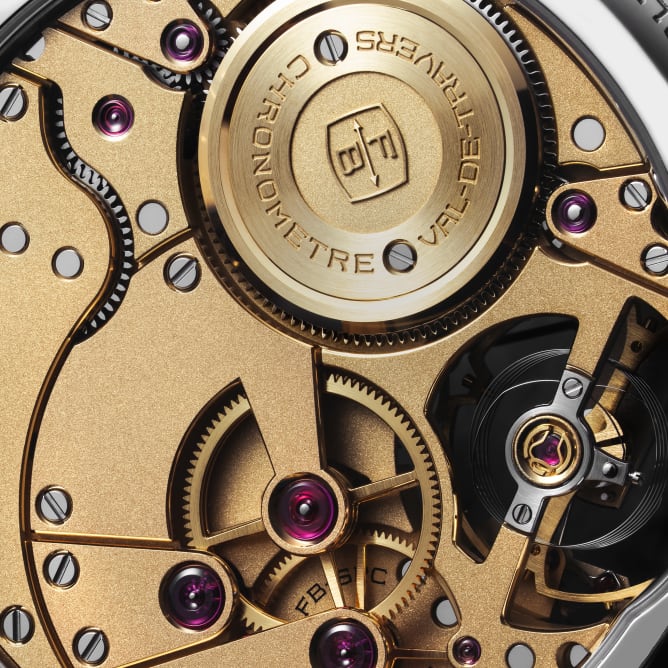
The open side of the dial helps explain what you are paying for: the balance, pallet lever and escape wheel are visible at 9 o'clock. Central hands show hours and minutes, small seconds sit below, and power reserve is near 2 o'clock. That creates a readable connection between motion and indications. The reverse deserves attention too: its bridges form a closely packed composition visible through the transparent back. An enthusiast of movement architecture has plenty to study here.
 Enlarge
FB-SPC bridges and gears viewed from the transparent back of the FB 3SPC.1 version.
© © Chronométrie Ferdinand Berthoud · SourceThe model's historical reference is the No. 26 decimal pocket watch made by Louis Berthoud in 1793. That helps explain the round shape and focus on the hairspring, but I would assess its modern execution and ownership conditions when choosing it. Water resistance is stated at 30 m, and the leather strap is alligator. For a rare regulating assembly, it is sensible to ask the brand in advance about available servicing, turnaround times and the cost of work.
The FB 3SPC.1 interests me because its rare mechanics are observable: their purpose is visible through the window and on the dial. That is a strong argument for a collector who values construction and finishing. If a date, automatic winding and sporting versatility are the priorities, those functions will need to be sought in another model. Here the deliberate choice is a hand-wound chronometer with an unusual regulating organ, rather than the greatest number of everyday conveniences.