
CREATIVE TIME · Practical guide
The movement in detail
The movement’s idea
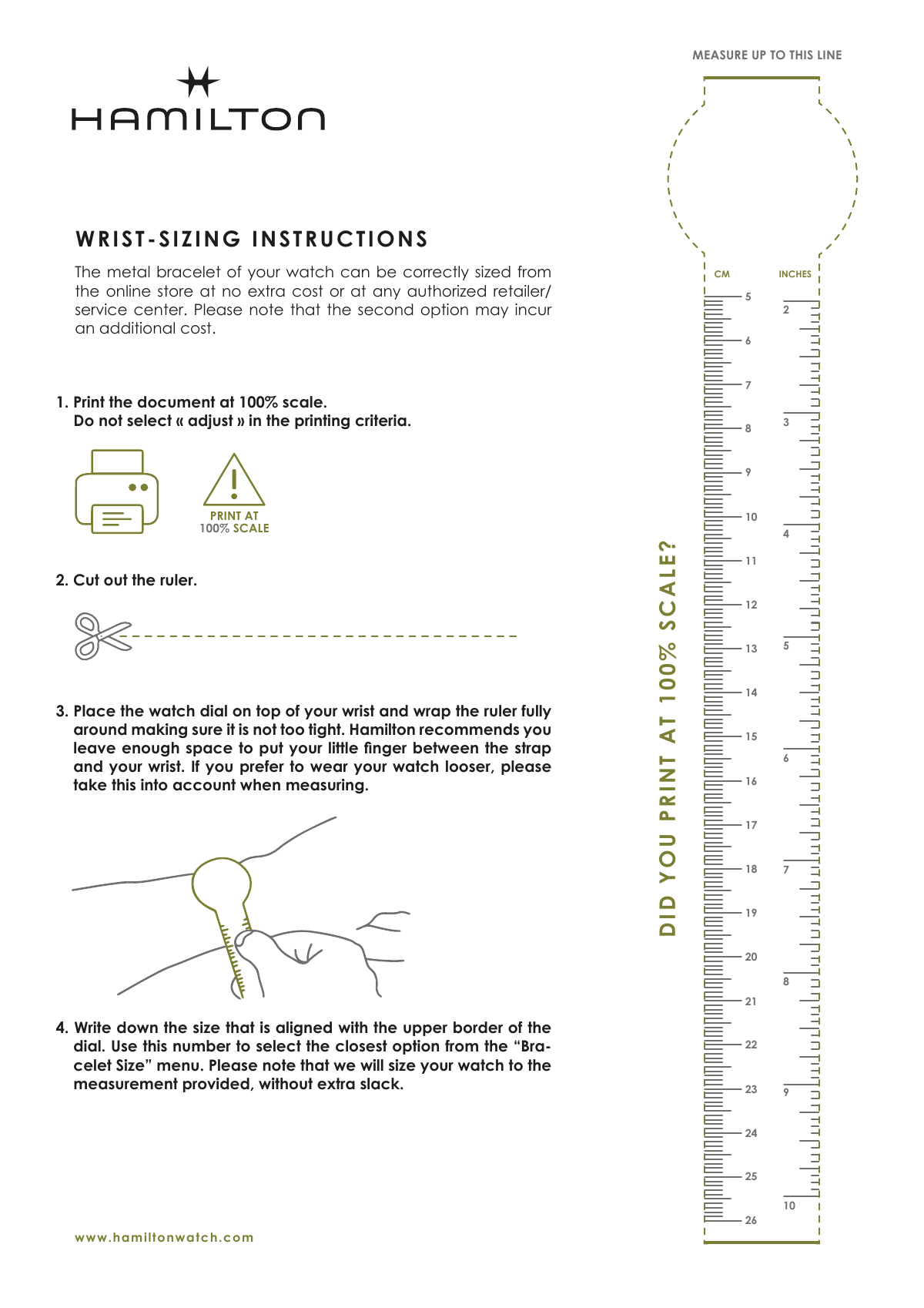
Start by measuring circumference where you wear the watch, but do not turn the result into a compulsory case diameter. People with the same circumference can have different widths across the top of their wrists. Hamilton’s bracelet-sizing instructions use circumference to determine bracelet length; they do not establish a suitable case diameter.
 Enlarge
Hamilton’s template for measuring wrist circumference and choosing bracelet length. To measure, download the original PDF using the Source link and print it at 100%, without fitting it to the page. An on-screen image does not retain physical scale; this ruler does not determine a suitable case diameter.
© Hamilton · SourceThe second measurement is lug-to-lug length. It shows how much space the case takes along the wrist. The official Hamilton Khaki Field Auto H70455153 listing gives a 38 mm diameter, 47 mm length and 11 mm thickness. This is an example from a past collection, not an announcement of a new release or current availability.
When trying the watch on, look from the side: the lugs should follow your wrist comfortably, without pressure or awkward overhang. Then check the bracelet. If its first link barely bends, the effective fit may be longer than the case measurement suggests. Comparing diameter alone misses that difference.
Practical meaning
Thickness and weight are particularly noticeable at a desk. Wear the watch with your usual shirt, bend your wrist and rest your arm on the desk to check for pressure from the crown or clasp. A case that looks good in a photograph can catch a cuff or move around as you do.
Assess the watch in a mirror from a normal distance. Phone close-ups are useful for details, but add a view of the whole arm when judging proportions. A wide bezel and a large open dial can create different visual impressions at the same outside diameter.
The practical sequence is to measure your wrist, find the diameter, lug-to-lug length and thickness, try two neighbouring sizes and adjust the bracelet before judging. With watches over 42 mm, pay particular attention to length and weight distribution. This is fitting advice, not a ban on large watches: comfort and the look you want are individual.