F.P.Journe · FFC
The movement in detail
The movement’s idea
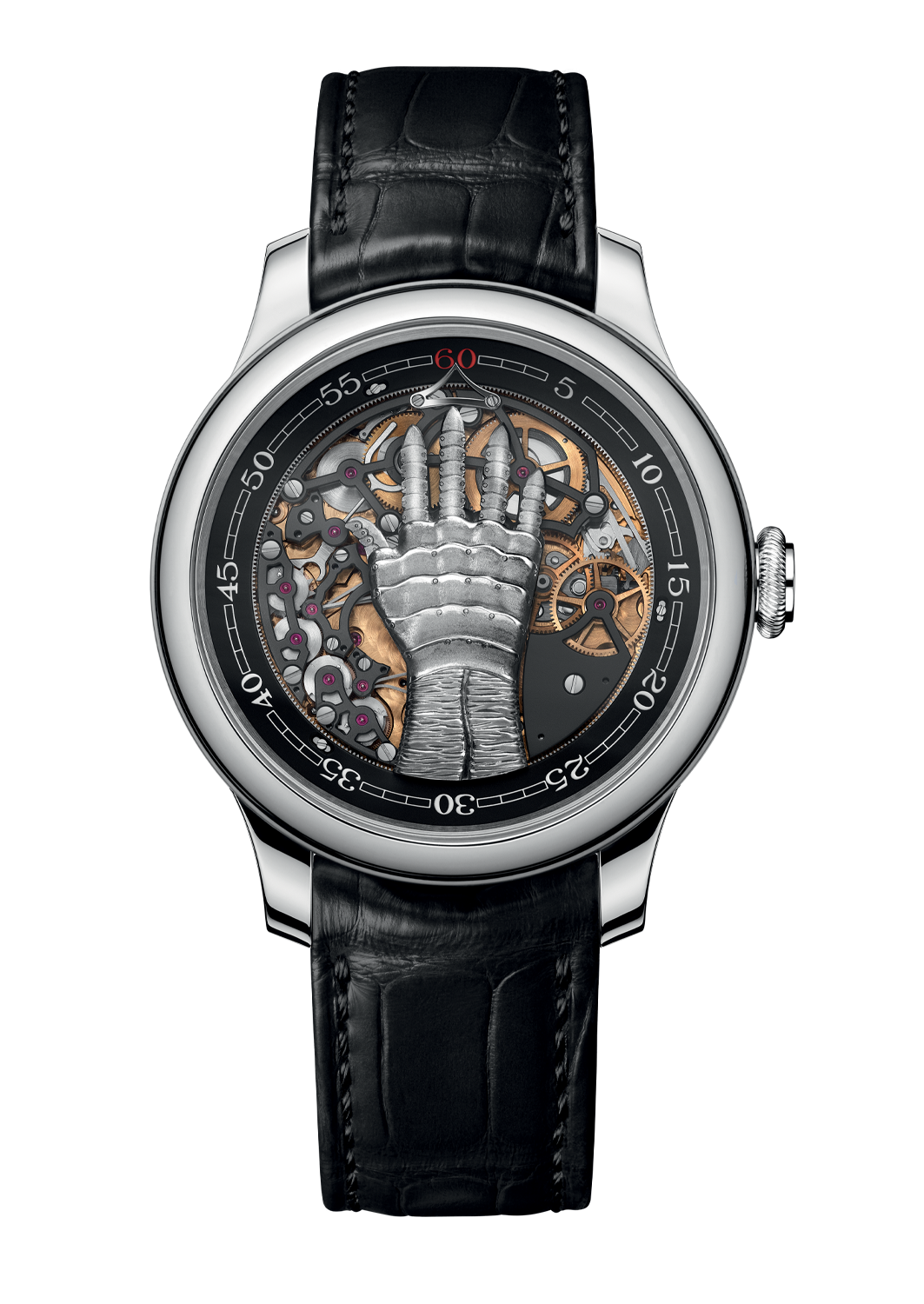
On the F.P.Journe FFC, the hour changes with a gesture: a titanium hand folds and extends its fingers while the minutes pass around a rotating ring. “Digital” here has nothing to do with electronics. The mechanism presents discrete hour values through finger positions rather than moving a pointer across a scale. Within the collection featured in F.P.Journe’s 2025–2028 catalogue, it is a particularly interesting example of a complication changing the language of a watch without adding another calendar function.
First, consider how to read it. Five fingers provide twelve coded combinations, so simply counting raised fingers is not enough. The catalogue includes a separate chart for all twelve hours. Minutes are read at a stationary pointer at twelve o’clock, with the appropriate mark on the rotating ring arriving beneath it. That means two different operations instead of the familiar glance at the angle between hands. For someone who enjoys mechanical puzzles, this is part of the pleasure; for someone who needs the time instantly, it is a reason to consider their willingness to learn a new code.
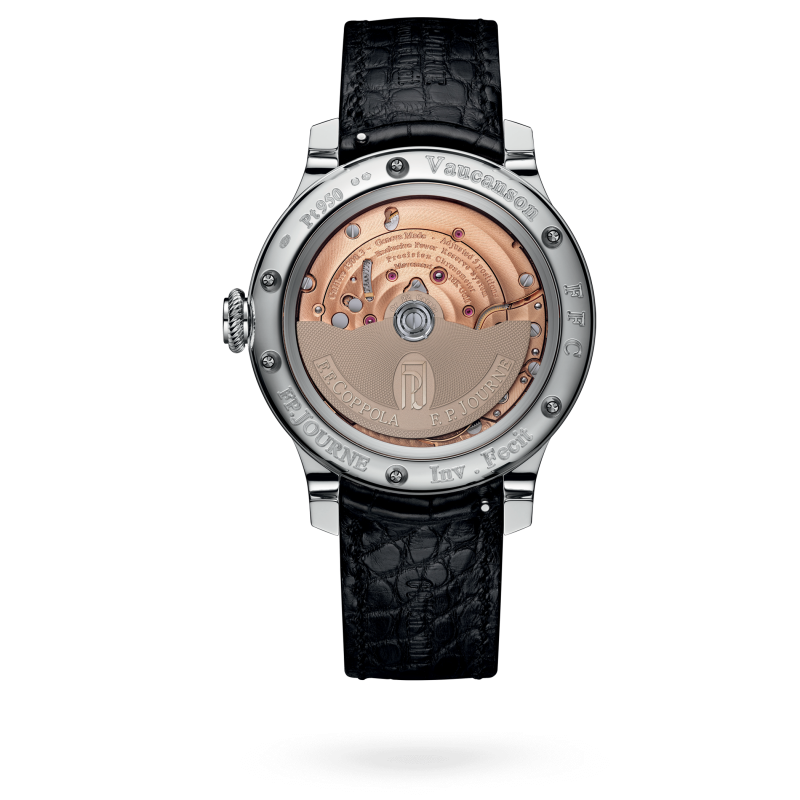
Beneath this stage is the automatic Octa 1300.3. But a family designation is no reason to import specifications from any other Octa: for the FFC, the manufacturer lists 396 movement components, 63 jewels and a height of 8.10 mm. The catalogue confirms an 18-carat rose-gold construction and an off-centre rotor in 22-carat white gold. Frequency is 21,600 vibrations per hour, or 3 Hz. The interesting challenge here is not a frequency race but fitting an automaton above a complete automatic movement.
Practical meaning
The main engineering problem appears when the hour changes. Moving several fingers together is a very different energy demand from continuously turning a light pointer. Between the primary gear train and the display, Journe installed a remontoir d’égalité, an intermediate energy store with a spring blade. Each hour the movement winds it over 40 minutes, then releases the accumulated energy on the hour to change the gesture. The demand for a brief, powerful movement is thereby spread over a longer charging period.
It is important not to confuse this device with a remontoire directly supplying the escapement in other watches. In the FFC it serves the display. The manufacturer explains the solution as a way of avoiding disturbance to the regulating organ when the fingers change position. That is an account of the design, not an independent accuracy measurement. The transition from five to six or nine to ten is particularly telling: according to the brand, four fingers move together. The buffer addresses precisely this kind of uneven load.
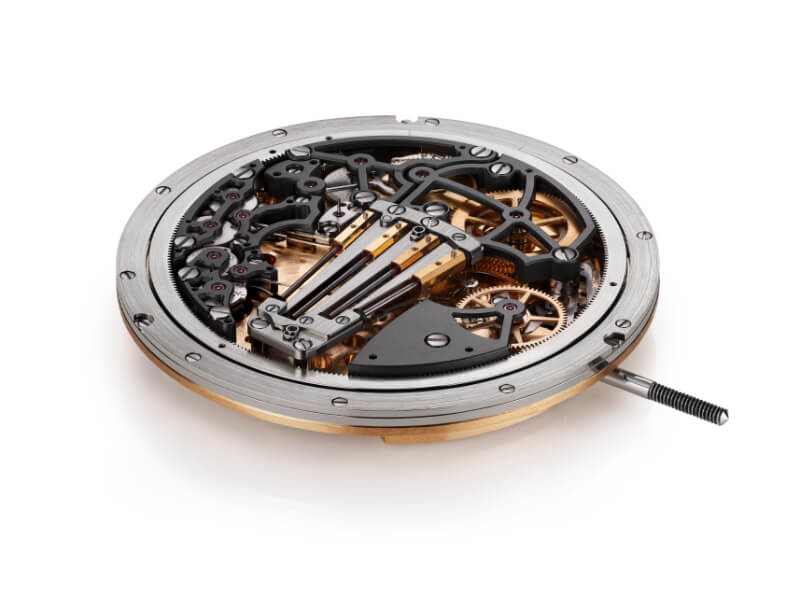 Enlarge
The display side of the FFC movement without the titanium hand, revealing the structure controlling its motion.
© F.P.Journe · SourceTen cams turning once every twelve hours determine the sequence of gestures. Through springs and levers, they control four fingers and the separate movement of the thumb. Titanium was chosen to reduce the moving hand’s mass, not merely for its colour. This is a good reason to linger over the exposed mechanism: the spectacle depends on the quite practical business of conserving energy and reducing friction. The hand’s appearance refers to an Ambroise Paré prosthesis, but for a movement enthusiast the FFC’s value lies primarily in how that image was made to function.
The stated power reserve is 120 ±12 hours, nominally five days; automatic winding makes this experiment less dependent on an owner’s daily ritual. The platinum case is 42 mm across. The official page contains a small thickness discrepancy: 10.7 mm in the description and 10.8 mm in the technical table. “About 10.8 mm” is therefore the sensible description, with fit best checked by trying it on. Diameter and the unusual organisation of space matter more than an attractive claim of compactness that guarantees nothing without a wrist and measurements.
 Enlarge
The back of the platinum FFC, with an off-centre rotor engraved F.F.COPPOLA and F.P.JOURNE.
© F.P.Journe · SourceThe FFC is interesting because it complicates the conversation with its owner rather than the information provided. It still tells the hours and minutes, but makes every new hour a mechanical event. For a collector already familiar with calendars and chronographs, that is a substantive change of subject: there is both a result and a cause of motion to watch. The everyday cost of this approach is chiefly a learning exercise: a beautiful gesture must first be learned before it can be read.