Lang & Heyne · Anton
The movement in detail
The most interesting feature of Anton is the empty space around its tourbillon cage. A large opening in the lower dial gives the rotating assembly its own stage, with the hour and minute hands above it. This is not an attempt to expose as much machinery as possible: the composition separates reading the time from watching the movement. White Grand feu enamel on the rose-gold version reinforces that contrast.
Calibre IX is manually wound and has a 55-hour power reserve. Its 11.1 mm minute tourbillon is supported from one side, leaving no bridge across the top of the cage. The lyre-shaped cage also indicates seconds. Frequency is 18,000 vibrations per hour, or 2.5 Hz. Here that slower rhythm matters primarily as part of the spectacle; a tourbillon alone does not prove superior accuracy on the wrist.
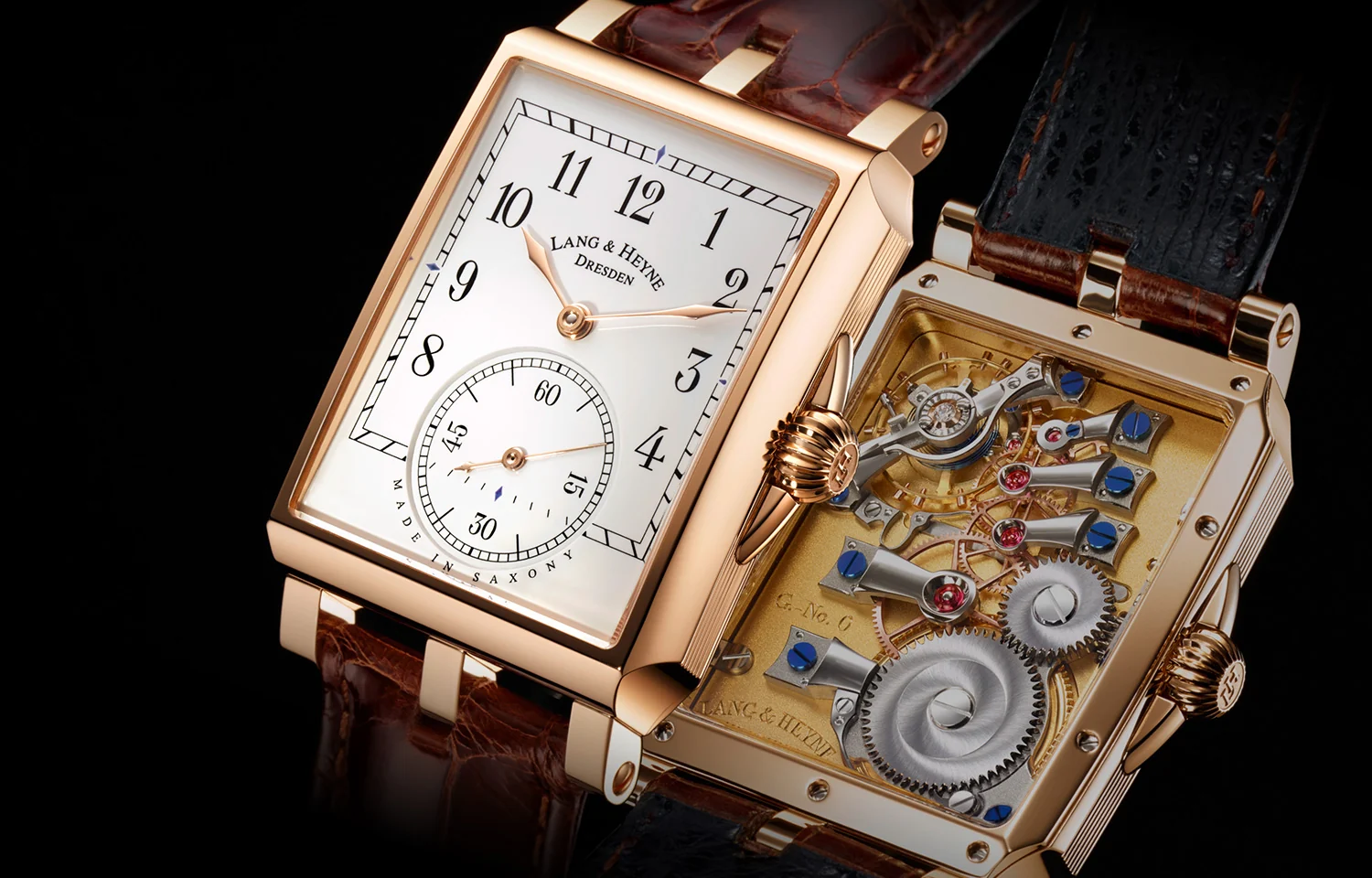
The case measures 40 × 32 mm without lugs and is 9.4 mm thick, establishing proportions unlike those of a conventional round watch. Comparing its width directly with a round watch’s diameter is misleading: length and the shape of the fit matter just as much. The rectangular 34 × 26.5 mm movement follows the case geometry. The architecture visible through the back deserves attention separately from the dramatic opening at the front.
 Enlarge
Calibre IX through the caseback: its rectangular architecture follows the case shape.
© Lang & Heyne · SourceFor an owner this is more a deliberate ritual than an all-purpose daily instrument. Manual winding creates regular contact with the mechanism, while 55 hours allows a day without winding but does not guarantee a full long weekend. Its stated 3 bar water resistance does not make Anton a sports watch. Its strength lies elsewhere: the complication is immediately legible without disturbing the calm composition.