Romain Gauthier · Logical One Black Titanium — Black Enamel Dial
The model in detail
Meet the watch
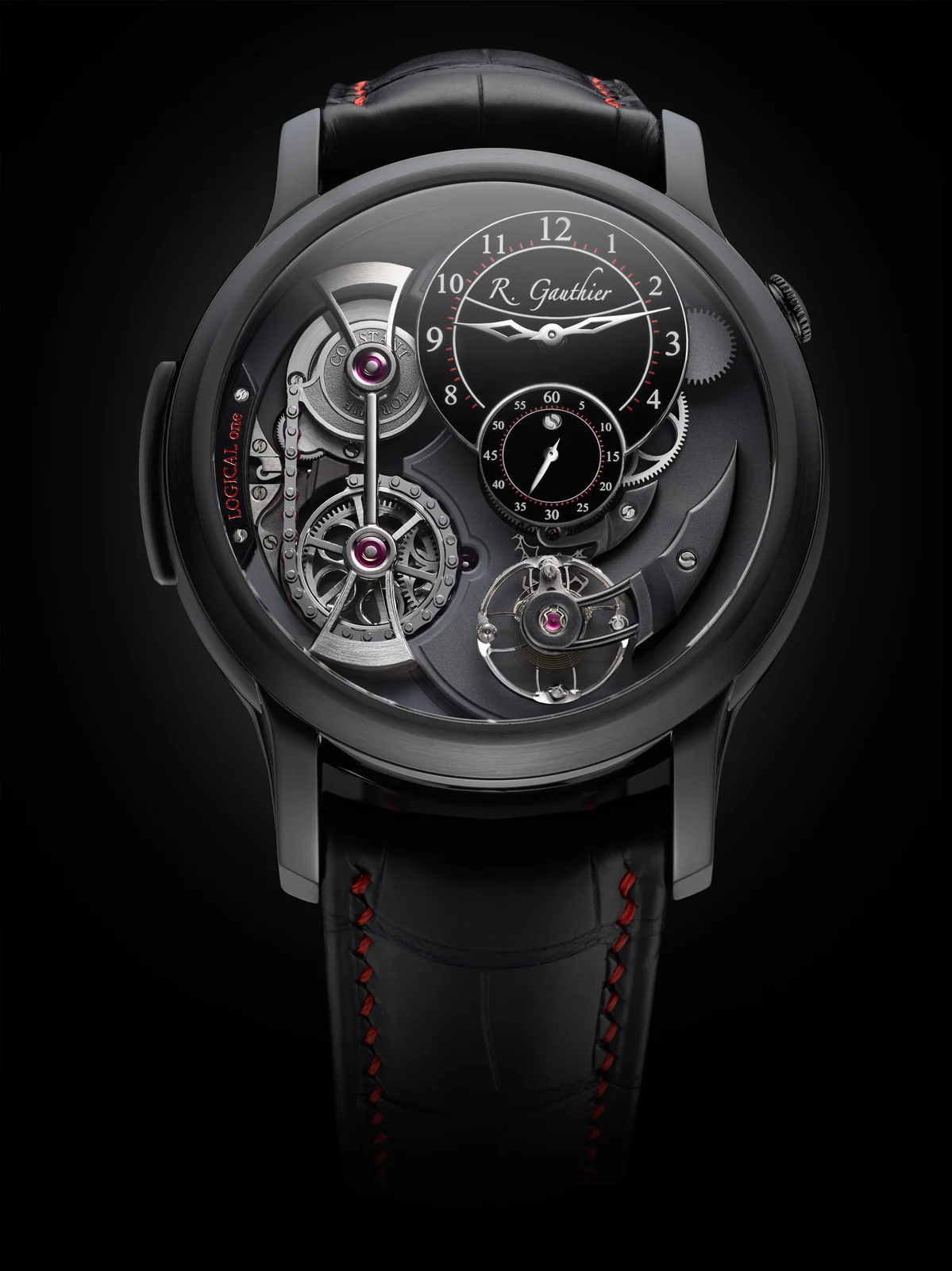
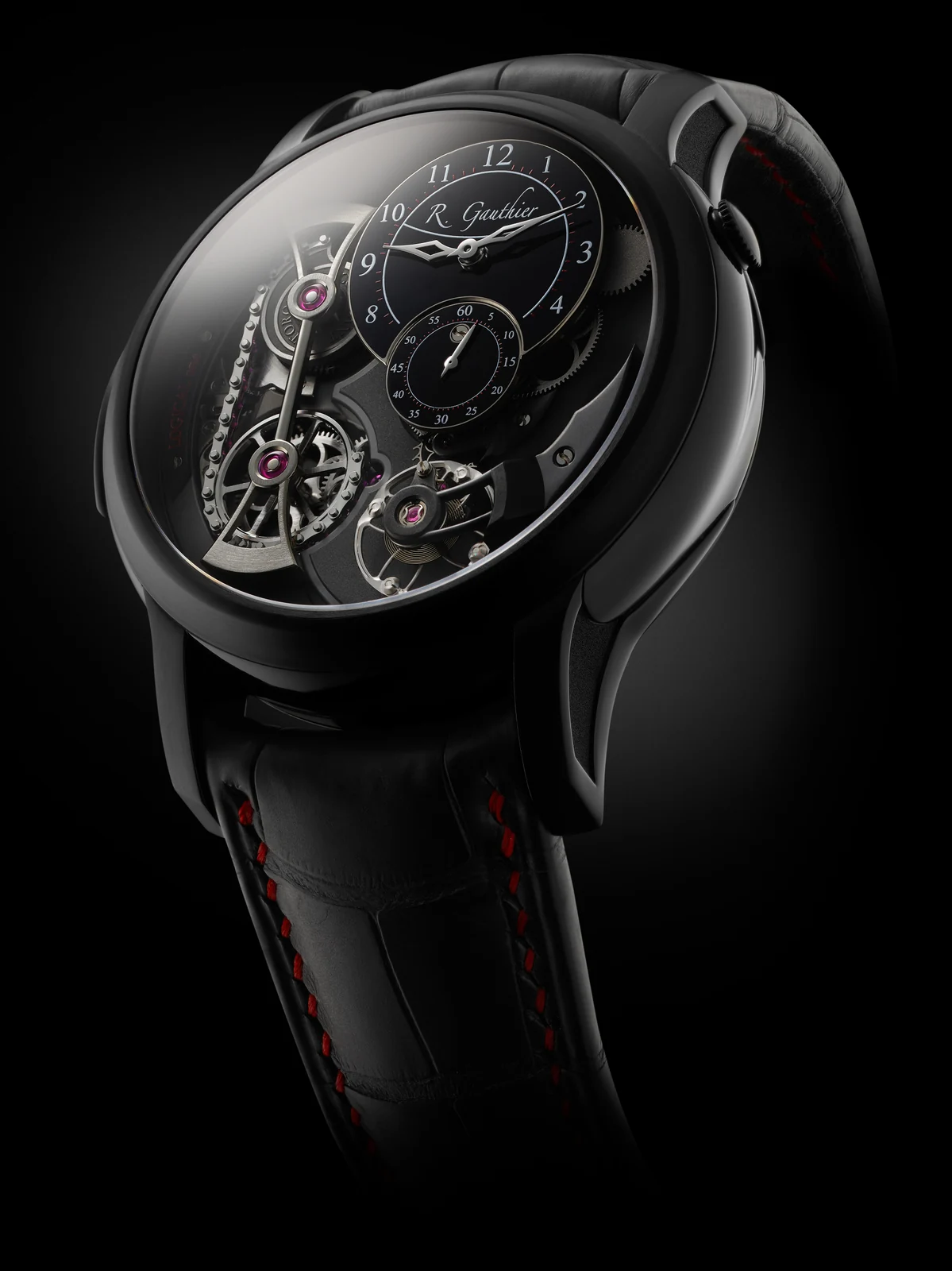
The chain on the front of Logical One invites inspection before you even check the time. It connects two large assemblies on the left, while the small time display sits on the right. Romain Gauthier made energy transmission a visible part of the composition. Our chosen version is MON00145: black titanium, black enamel and red accents. The manufacturer dates this version to 2015–2020. Its technical idea still offers more to discuss than another additional indicator.
As a mainspring unwinds, the force it supplies changes. This is one reason why maintaining consistent working conditions for a watch balance is difficult. Logical One addresses the problem with a flat, snail-shaped cam whose effective radius changes as the chain travels. The cam and barrel sit on the same plane. The old principle of compensating for changing force with a chain and fusée thus gains a different geometry. The aim is a more even energy supply over the stated 46-hour running time.
The chain deserves a closer look. Its structural links are steel, while rollers made from synthetic ruby work at the contact points. A ‘ruby-link chain’ therefore does not mean a chain carved entirely from gemstones. It uses 26 rubies in addition to the movement’s own 37 jewels. The manufacturer explains the design in terms of reduced friction and wear; detachable connections aid servicing. Following the chain’s route in the photograph helps explain why such a complex assembly belongs in a three-hand watch.
Details and limitations
The second unusual detail is on the case. A pusher at 9 o’clock winds the spring, while a small crown near 2 o’clock sets the time. Force from the pusher reaches the barrel on the same plane. It offers the owner a different way of interacting with the mechanism: press the separate winding control, then inspect the energy reserve on the back. With around 46 hours of reserve, regular manual winding remains part of everyday ownership; there is no automatic winding system.
 Enlarge
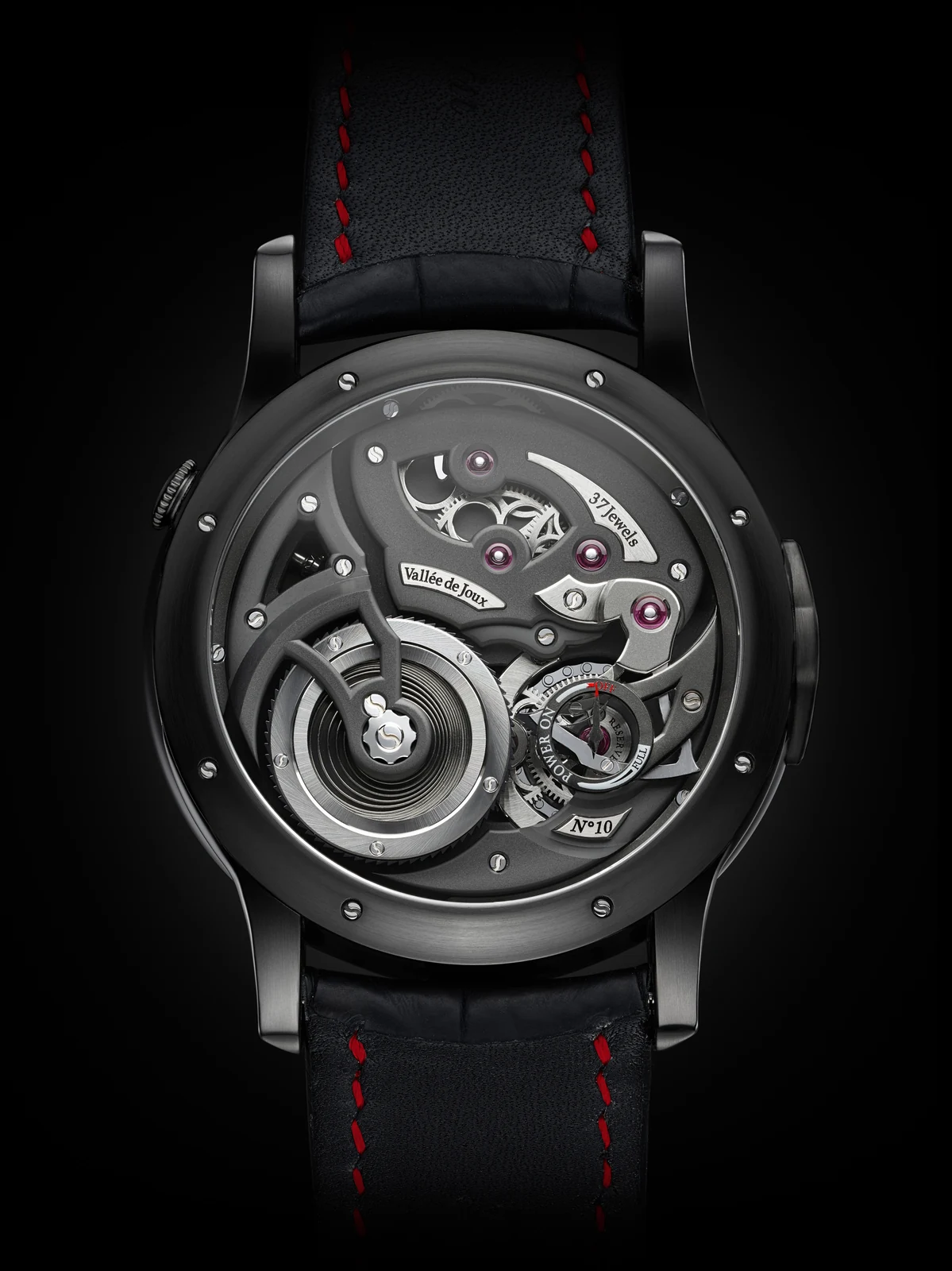
The back of Logical One reveals the mainspring and power-reserve indicator.
© © Romain Gauthier · SourceThe in-house calibre runs at 4 Hz, or 28,800 vibrations per hour. Its individual character extends beyond the chain transmission: the balance has curved spokes and eccentric adjustment weights, the pallet lever has a triangular structure, and the wheels have distinctive circular openings. The mainspring sits between sapphire plates intended to reduce uneven friction. These details serve a shared purpose: managing energy. They are more interesting as a connected system than as a list of patents assembled to produce an impressive number.
The black titanium version makes this architecture particularly clear. Polished areas sit beside satin-finished surfaces, while the light markings on the enamel dials separate the indications from the surrounding components. Grand Feu enamel is applied to a white-gold base; the hour and minute hands are also white gold. In our view, the dark palette brings the composition together: the eye can move from the time to the chain and balance without jumping between numerous colours. The red details provide a measured accent along that route.
 Enlarge
An angled view shows the case volume, separate dials and exposed chain transmission.
© © Romain Gauthier · SourceThe case is substantial: it measures 43 mm across and 14.2 mm thick, with a lug-to-lug length of 53 mm. That final figure is especially useful when considering a smaller wrist. Titanium alone does not guarantee compact dimensions. Water resistance is rated at 30 metres, so we would see Logical One primarily as a watch for calm everyday wear. The opportunity to study its construction matters more here than versatility across every possible activity.
Logical One is convincing because its appearance grew from a mechanical problem. Even the winding pusher participates in that logic. For a collection already containing good classical three-handers, this model introduces another subject to explore: how a watch receives and uses energy. However, mechanical complexity alone does not prove that a particular example keeps better time. Our selection rests on the originality of the solution and its expressive execution; the actual performance and condition of an older example require separate assessment.