Voutilainen · 28CG Rose Gold
The model in detail
Meet the watch
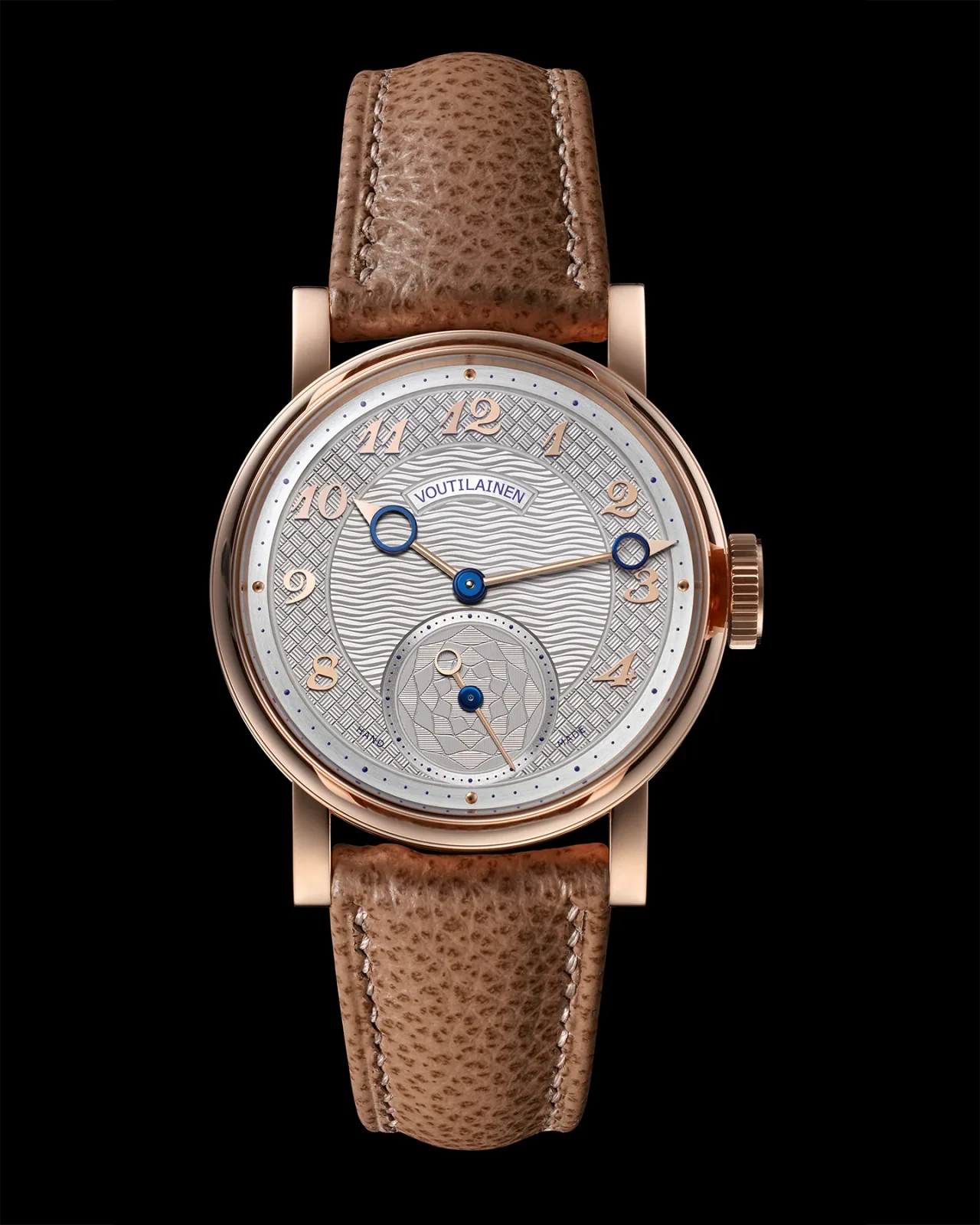
There is plenty to hold the eye on the front of Voutilainen 28CG: several guilloché patterns, applied Arabic numerals, hands with circular tips and small seconds. But the main reason to include it in a selection of watches with unusual calibres emerges on the back. Beneath the transparent caseback is the in-house calibre 28 with two escape wheels. We examine the rose-gold version introduced in 2025: its 37 mm diameter preserves classical proportions, while its internal construction deserves a separate discussion.
An escapement meters the energy reaching the balance and connects its oscillations to the movement of the hands. In calibre 28, two wheels deliver impulses directly to the balance through the roller and impulse jewel. The manufacture describes this architecture as a means of reducing energy requirements compared with a Swiss lever escapement. The important point is the problem being addressed: the watchmaker is changing the way impulses are delivered, with consequences throughout the movement. A watch displaying only hours, minutes and seconds can still be mechanically substantial.
The practical result listed in the specifications is 65 hours of power reserve. That is a little more than two and a half days: fully wound on Friday evening, the watch should still be running on Monday morning if conditions match the stated specification. Frequency is 18,000 vibrations per hour, or 2.5 Hz. Choosing this kind of mechanism on a ‘higher frequency is better’ basis misses the point. The interest lies in balancing energy consumption, escapement design and operating rhythm. A claim of more efficient energy delivery also does not replace measuring the accuracy of an individual watch.
Details and limitations
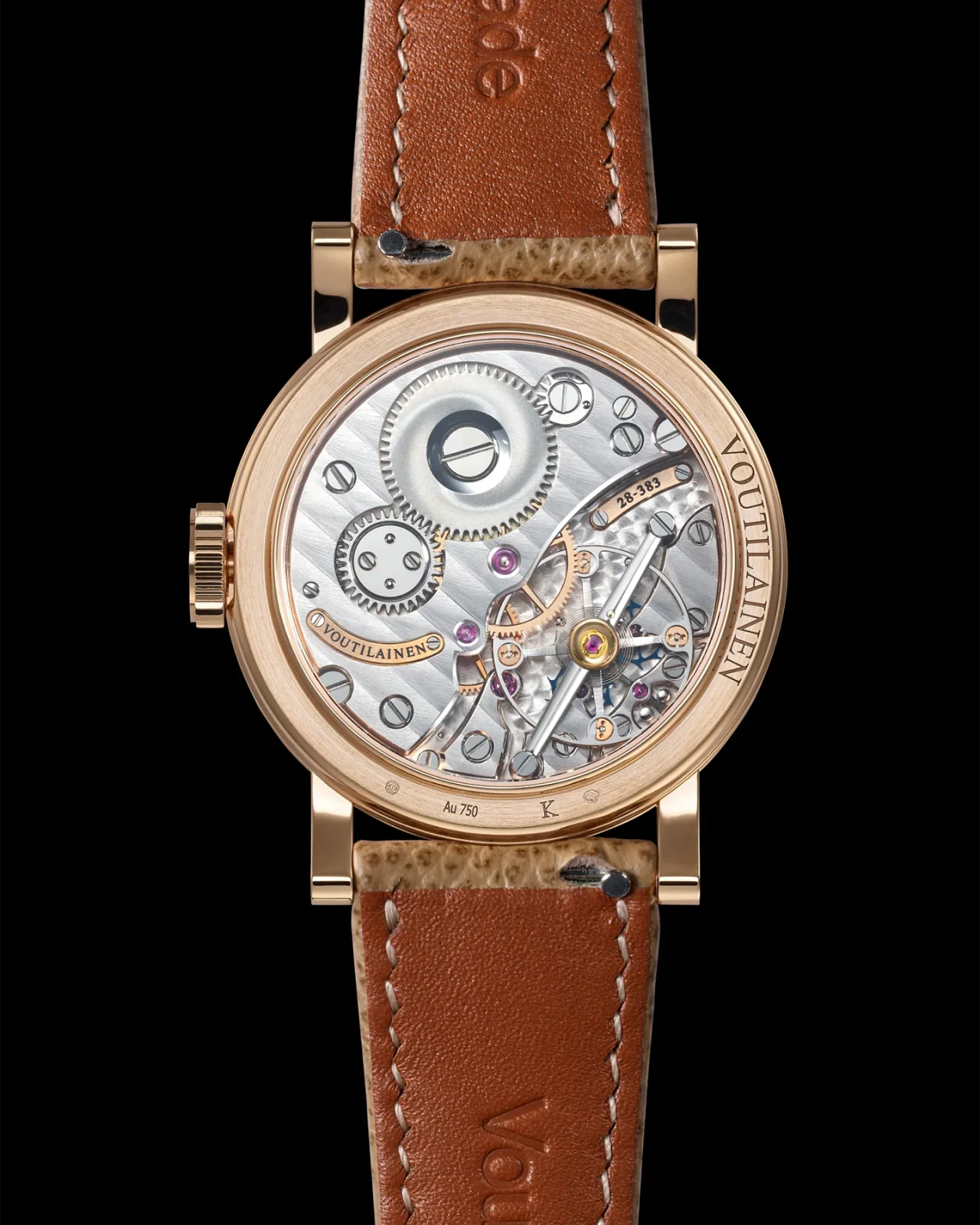
The 13.5 mm balance occupies a significant part of the movement. The rate is adjusted through rose-gold weights on its rim, changing the inertia of the balance. The hairspring uses two specially shaped curves: an outer Phillips terminal curve and an inner Grossmann curve. Their purpose concerns how the spring expands and contracts during each oscillation. It is a good example of a calibre’s originality being concentrated in its regulating assembly, even when the dial has neither a tourbillon nor additional scales.
 Enlarge
Calibre 28 through the caseback: a large balance, German-silver bridges and hand finishing.
© © Voutilainen · SourceCalibre 28 is also interesting for the way it is made. The workshop states that it designs, manufactures, finishes and assembles the movement in-house. The main plate and bridges are German silver; the visible wheels are 18-carat gold and the escape wheels are steel. Voutilainen’s production account distinguishes machining the components from their subsequent hand finishing. The movement is first assembled for adjustment, then taken apart for decoration before final assembly. This sequence explains why it is worth examining both the mechanical layout and the execution of each transition between surfaces.
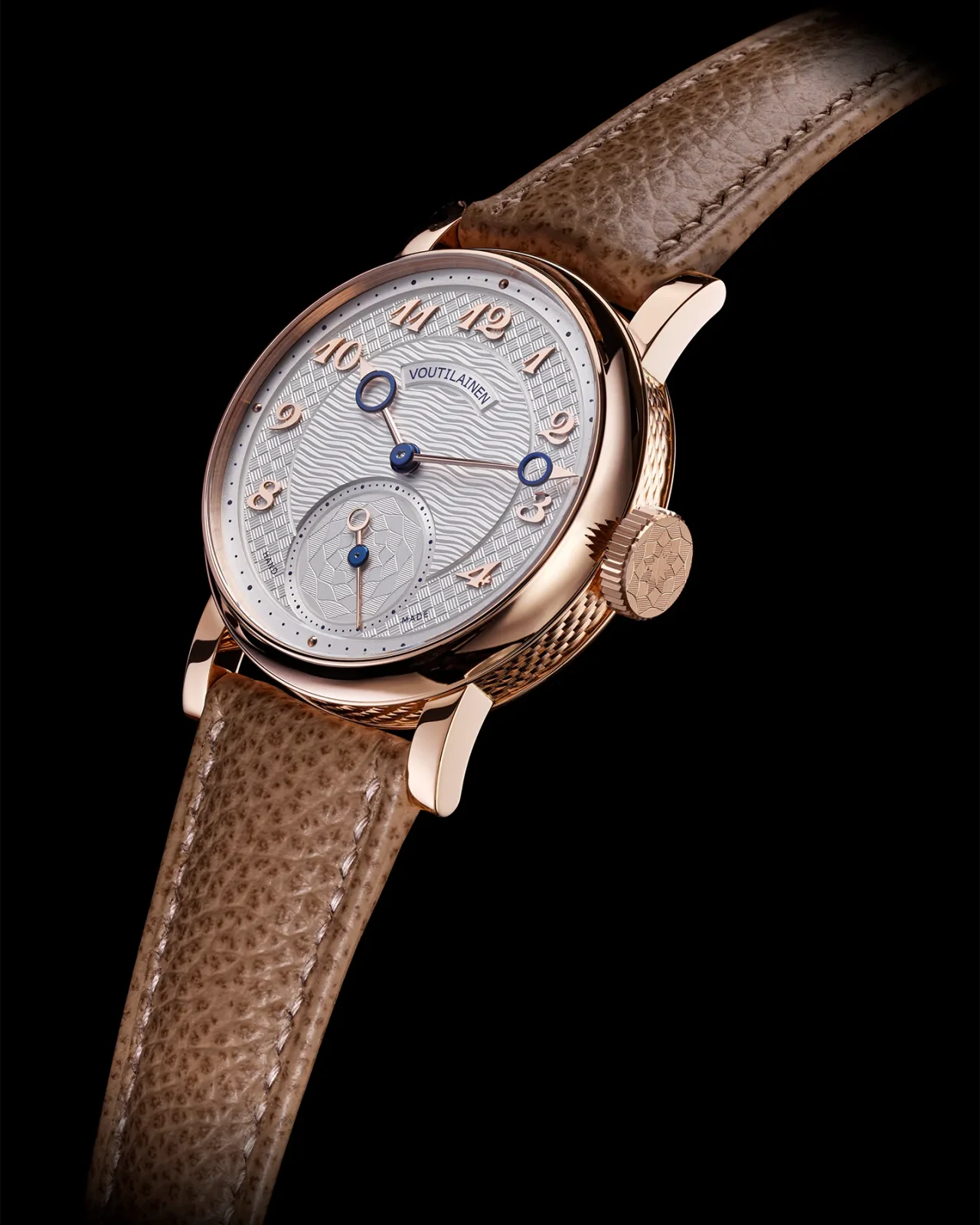
Texture is equally important on the dial side. The white dial carries hand guilloché that continues onto the case and winding crown. A concave bezel and straight lugs frame the complex decoration; the hands combine gold and blued steel. In our view, this combination works particularly well at a compact size: the pattern rewards close inspection, while the overall composition remains easy to recognise. A beige calfskin strap supports the warm colour of the gold without introducing another strong colour accent.
 Enlarge
The guilloché decoration continues from the dial onto the caseband and winding crown.
© © Voutilainen · SourceCompactness has specific limits. The manufacturer’s GPHG entry gives a thickness of 11.3 mm and water resistance of 30 metres. A 37 mm diameter should therefore not automatically be read as a promise of an ultra-thin fit or sporting versatility. Manual winding requires a routine, and there is no remaining-power indicator on the dial. For an owner who switches watches frequently, the choice is straightforward: maintain a regular winding rhythm or be ready to set the time again after a longer break.
The appeal of 28CG is its combination of straightforward indications and deeply individual mechanics. We chose it for this series because a restrained-looking watch contains an independent answer to a fundamental watchmaking problem. The solution does not require explaining a dozen buttons to its owner, yet it gives a good reason to study the escapement. Hand guilloché extends the same attention to detail that is visible in the movement. This coherence makes the model convincing for a collector who values both the technical idea and the quality of the object.