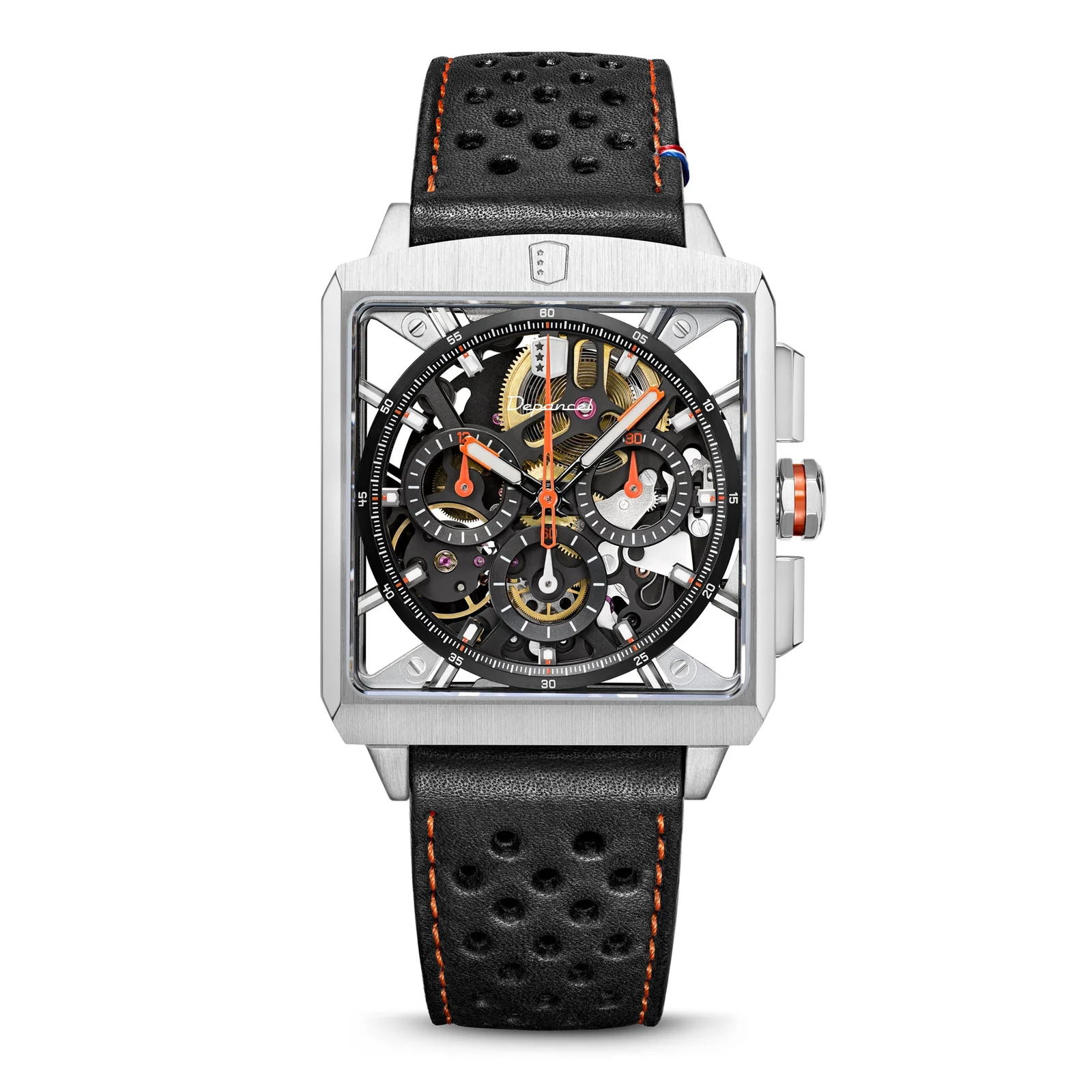
Depancel · Autosport Les 2 Tours d’Horloge
The model in detail
Meet the watch
The pusher at two o’clock looks like a chronograph control, but Depancel has given it another job. On the new Autosport Les 2 Tours d’Horloge, it advances the month pointer, which becomes a manually operated tally of elapsed hours during a race. This is a calendar watch with an unusual interaction, not a stopwatch. That distinction makes the small edition more interesting than a conventional souvenir carrying an event logo.
The edition celebrates the historic-car endurance race at Circuit Paul Ricard. The manufacturer lists November 7–8, while MONOCHROME reports that sales begin on November 5, 2026, at 4 p.m. Paris time. On the morning this article appears, the sales opening is still ahead. Production is limited to 100 numbered pieces; the French page shows a starting price of EUR 795 including taxes. Deliveries outside the European markets listed by the brand may attract additional taxes and duties.
There are two scales on the right: 1–12 and a yellow 13–24. Depancel intends the wearer to press the button and advance the hand after every completed hour of racing. The watch neither recognises the start itself nor independently measures the interval. A missed press means a missed marker, and the pointer needs to be restored to its calendar meaning after the race. This is more of a mechanical reminder for a participant or spectator than a timing instrument for a team.
 Enlarge
Right: a calendar pointer with two scales for manually tallying race hours. The pusher above the crown advances the hand.
© Depancel · SourceDetails and limitations
Inside is the Japanese Miyota 9122: an automatic calibre with hand-winding capability, hacking seconds, and day, date and month displays. Miyota specifies 26 jewels, 28,800 vibrations per hour and approximately 40 hours of running time. Hacking helps set the time precisely, but the reserve does not cover a typical break from Friday evening to Monday morning. If this watch rotates with others, winding and calendar setting will become part of the routine.
The steel case measures 39 mm across and 46 mm from lug tip to lug tip. Those figures are more useful for an initial assessment of fit than diameter alone, although they cannot replace trying it on. Thickness including the crystal is 12.6 mm: beneath its domed sapphire, the watch has more volume than the compact face might suggest. The stated 50 m water resistance does not make this racing model a dive watch; the leather strap is also best kept away from water.
The dial has character even without an explanation of the racing function. A grey centre, pale outer track and two differently shaded subsidiary displays form a composition around the yellow seconds hand. Saturday and Sunday are picked out in the same colour. The weekday on the left and the date below remain useful everyday information, while Super-LumiNova C1 on the time indications helps in dim light. We have not measured how long the glow lasts.
The rear crystal reveals a rotor with a radiator-grille pattern; the Les 2 Tours d’Horloge emblem is printed on the glass above it. This is a decorative automotive connection, not a technical alteration to the base 9122. The manufacturer identifies French assembly, while the calibre remains Japanese. That approach allows the watch to be judged on design and execution without attributing an in-house manufacture movement to it.
 Enlarge
The Miyota 9122 with a decorated rotor and race logo on the rear crystal. The case inscription identifies French assembly.
© Depancel · SourceThe audience for this idea is clear: a historic-racing enthusiast who enjoys taking part in a small watchmaking ritual. If you need a genuine chronograph to measure a lap, the Autosport does not do that job. Instead, a calendar automatic gains a convincing theme without a complex new movement. Before buying, compare the leather-strap version with the steel-bracelet option and check the final price of the selected configuration rather than applying the EUR 795 starting price to every version.